Escaping the Cat: Geometry, Genetic Optimisation and Deep Reinforcement Learning
This presentation investigates whether a rat trapped at the centre of a circular pond can escape a cat that runs around the edge four times faster than the rat swims. It first explains angular velocity and demonstrates why simple dashing, circling and continuously fleeing tactics fail. A geometric solution combines circling within one quarter of the pond radius with a final dash; viable circling radii lie approximately between 21% and 25% of the pond radius. A genetic algorithm then improves a predefined strategy by optimising how the rat blends fleeing and radial dashing. The final section replaces prescribed tactics with a deep reinforcement learning agent trained using PPO in a simulation that includes inertia, velocity and acceleration. Across the reported trials, the learned policy escapes successfully and typically reaches safety in 20–45 seconds, compared with about 130 seconds for the earlier circle-and-dash example, although the simulations use different physical assumptions. The presentation concludes by relating experience-driven autonomous control to potential robotic and unmanned-system applications.
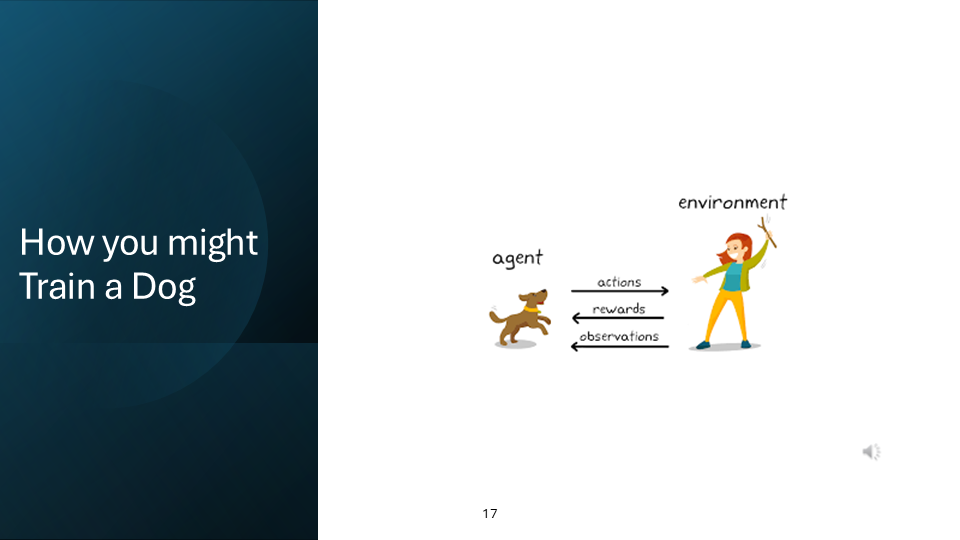
Observations, Actions and Rewards
Uses teaching a dog to fetch as an analogy for reinforcement learning. The dog observes its surroundings, chooses actions after seeing a stick thrown, and receives a reward if it retrieves and returns the stick. Repetition strengthens behaviour that leads to the desired result. The example separates the learning loop into observations, actions and rewards, providing an intuitive model for the equivalent interactions between an AI agent and its environment.
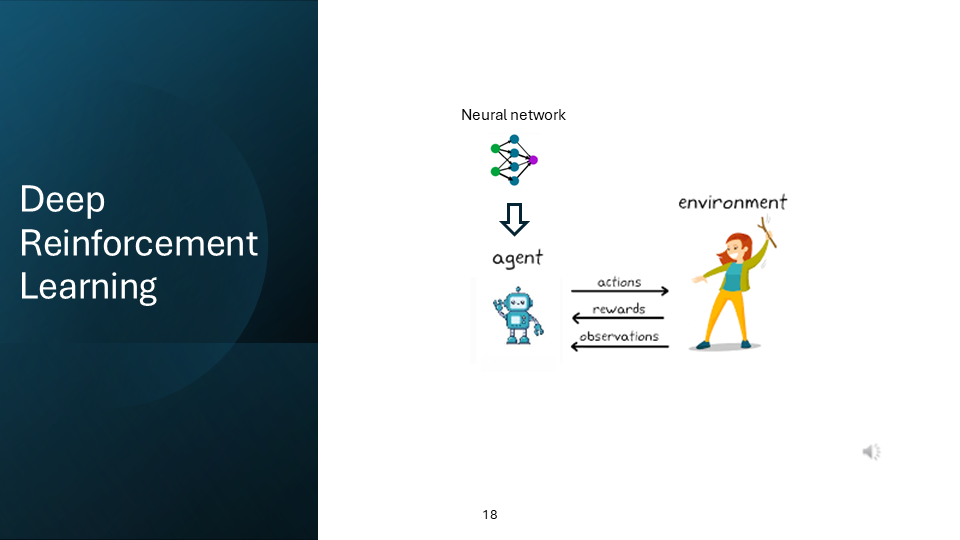
The Deep-RL Agent–Environment Loop
Maps the dog-training analogy onto an AI system. The agent receives environmental observations, including physical sensor data in a robotic application, and selects actions through an artificial neural network. Successful outcomes produce numerical rewards, while an optimisation process seeks to maximise accumulated reward. Training changes the policy network so that, from information about the environment and the agent’s state, it increasingly selects actions that advance its goal.
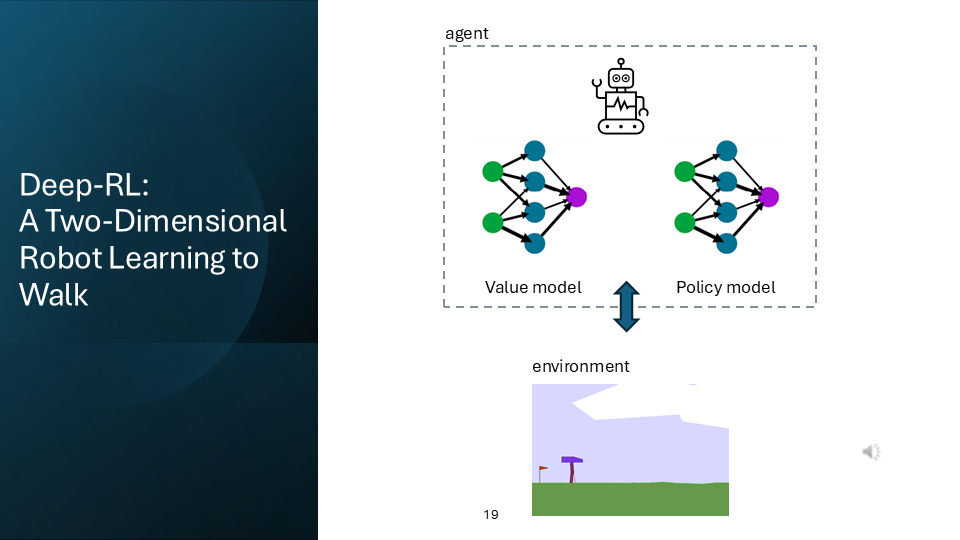
PPO Example: A Robot Learning to Walk
Illustrates PPO with the Gymnasium Bipedal Walker Version 3 environment. A two-dimensional simulated robot receives joint positions and velocities and outputs joint torques while rewards and penalties measure its walking performance. PPO, or Proximal Policy Optimisation, limits policy changes during each update to improve stability. As an actor-critic method, it uses a policy network to choose actions and a value network to estimate the quality of the current state. An early training example shows unstable movement.
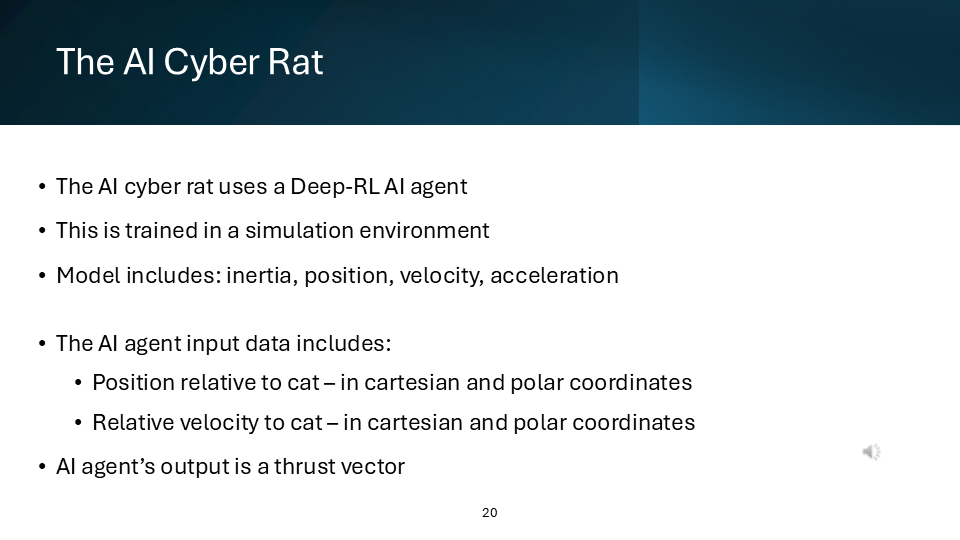
Cyber Rat Simulation and Control Inputs
Defines the cyber rat’s training environment. Unlike the earlier simplified demonstrations, this simulation includes positions, inertia, velocities and accelerations, so the rat cannot change direction instantaneously; the original circle-and-dash manoeuvre therefore fails under these dynamics. The agent observes its position and velocity relative to the cat in Cartesian and polar coordinates, along with scalar speeds projected onto selected directions. Its policy outputs a thrust vector that controls the rat’s motion.
The AI Cyber Rat’s Learned Strategy
Presents four trained-policy trials with slightly randomised starting positions and velocities. The cyber rat follows complex paths, sometimes moving toward Boris and sometimes away, and achieved a 100% escape rate across the reported simulations. Its policy appears to anticipate and exploit Boris’s reactions, although the exact mechanism is not immediately clear. It usually escapes with good separation in 20–45 seconds, versus about 130 seconds for the earlier narrow circle-and-dash escape; however, the later simulation includes inertia and other different physical assumptions.
Conclusions and Wider Relevance
Concludes that the geometric puzzle has a valid circle-and-dash solution, but a deep reinforcement learning agent can discover a substantially different and more effective policy without being given that sequence. In the reported trials, the learned movements consistently outmanoeuvre the cat despite being difficult to interpret. The presentation identifies this simple two-dimensional example as relevant to autonomous control and notes the increasing use of AI-enabled unmanned systems, including the possibility that such systems may directly encounter one another in combat.
The End
Closes the presentation following the comparison of geometric, genetically optimised and deep reinforcement learning escape strategies.