Deep Reinforcement Learning for Air-Defence Interception
This presentation examines whether Deep Reinforcement Learning can enable an air-defence interceptor to develop its own interception strategies. It first frames interception as a pursuit problem and explains how relative speed, agility, geometry and precision affect feasible approaches. It then introduces Deep-RL, in which a neural-network policy learns from observations, actions, rewards and penalties. A PPO-based agent is trained in a two-dimensional simulation to control missile thrust and detonation under noisy, slowly updated inputs. Two interceptor configurations are compared against a Mach 1 target: a Mach 1 “slow” missile and a Mach 2 “fast” missile, both limited to 10g acceleration. After training, the slow missile learns to aim ahead and intercept approximately sideways, while the fast missile passes the target, turns and attacks from behind to reduce relative velocity. Both achieve 100% success in the presented simulated tests. The presentation concludes that learned strategies depend strongly on relative capabilities and that realistic environments, evasive-target modelling and operational telemetry could support further development.
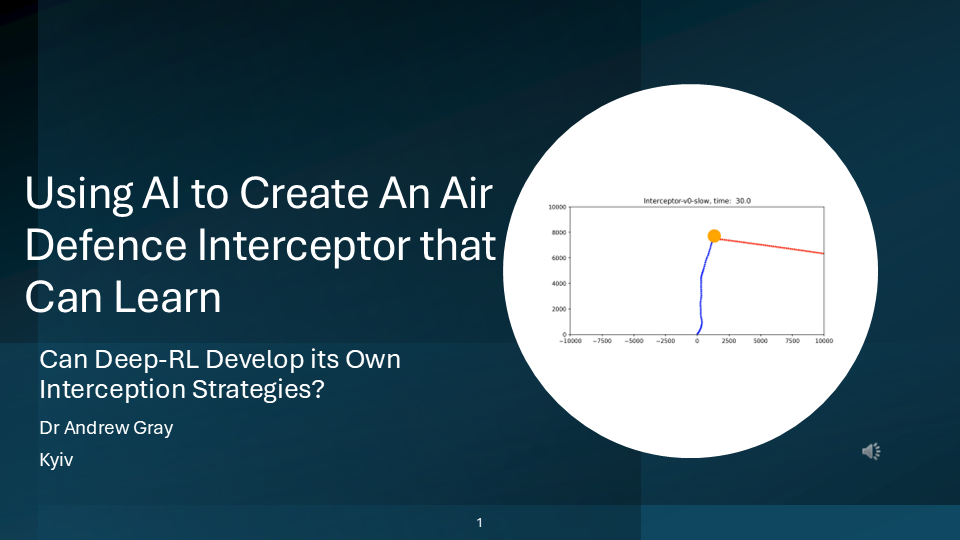
Using AI to Create a Learning Air-Defence Interceptor
Introduces the use of Deep Reinforcement Learning to train an AI-controlled air-defence interceptor in a two-dimensional pursuit simulation. The AI agent’s neural-network policy learns interception behaviour through interaction rather than following a prescribed strategy. The presentation compares performance early and after training, then examines how two missiles with different maximum speeds develop distinct tactics relative to the target’s capabilities. The examples remain two-dimensional for clarity, although the method could be extended to three dimensions.
Presentation Roadmap
Outlines the six-part structure: defining the interception problem and possible strategies; describing an interceptor that learns from experience; explaining Deep Reinforcement Learning; detailing the two-dimensional training environment; comparing the learned strategies of two missiles with different performance characteristics; and presenting conclusions. The progression moves from basic pursuit dynamics and AI concepts to the simulation design and the resulting post-training behaviours.
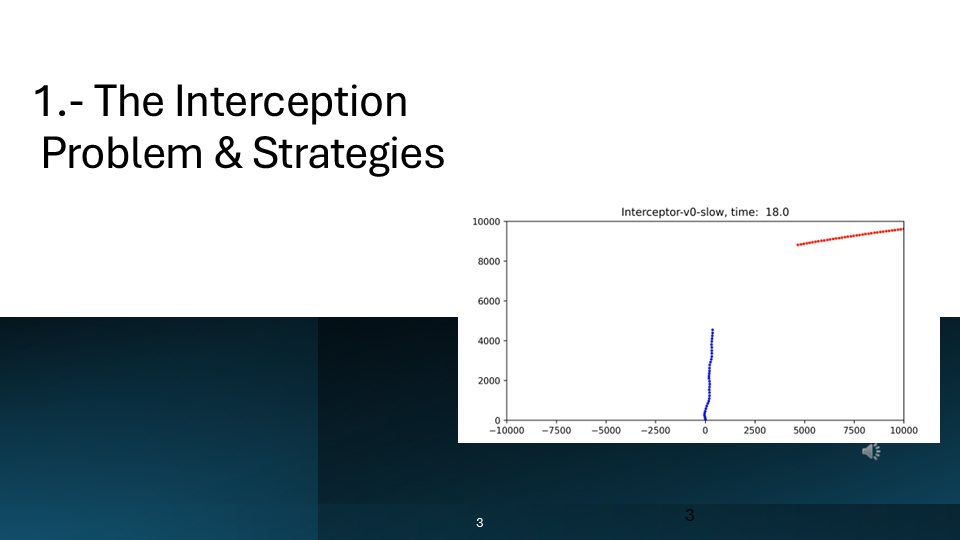
The Interception Pursuit Problem
Opens the first section by defining the task as a pursuit problem. An AI agent controls an air-defence interceptor whose objective is to manoeuvre toward an aerial target, reach a suitable engagement position and destroy it. The trajectory plot previews the relationship between the moving target and the interceptor path that will be analysed throughout the presentation.
Interception Objectives and Constraints
Defines the simulated interception problem in more detail. The target travels at constant speed along a simple curved path resembling a ballistic arc, while the AI-controlled interceptor has specified maximum velocity and acceleration limits. It must manoeuvre toward and destroy the target before the target exits the training area. Success is probabilistic and depends on interceptor–target separation at detonation, so the objective is to maximise the chance of interception within the available window rather than merely approach the target.
Two Simple Interception Strategies
Contrasts two intuitive strategies and their limitations. Direct pursuit—continually moving toward the target—may fail when target and interceptor speeds are comparable or fuel is exhausted. Predictive pursuit aims at an extrapolated future target position, but can produce an approximately 90-degree crossing with high relative velocity, demanding precise timing and accuracy. Rather than imposing either method, the experiments allow the Deep-RL agent to discover its own interception policy.
Simple Interception Dynamics and Isochrones
Introduces the physical factors affecting interception: relative speed, relative acceleration or agility, and guidance precision. A simplified model assumes a target moving left to right at fixed velocity and an interceptor travelling in a straight line at fixed speed from any starting position. Contours called isochrones connect positions with equal interception time; areas without contours have no solution. The plotted values are relative times, becoming seconds if speed is one metre per second and distance is measured in metres.
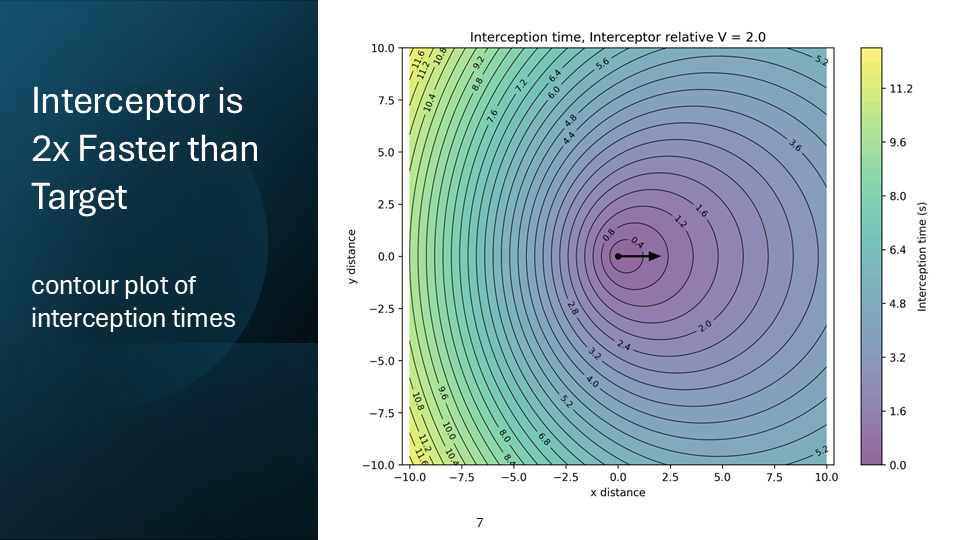
When the Interceptor Is Twice as Fast
Shows interception-time contours when the interceptor is twice as fast as the target. Approaching from behind gives a low closing speed and longer interception time, while a head-on approach is faster but increases relative velocity and the risk of missing. In this simplified case, the interceptor can reach the target from any starting point. The comparison anticipates a key result: when capabilities permit, the trained agent favours a rear attack because its lower relative velocity improves the simulated probability of success.
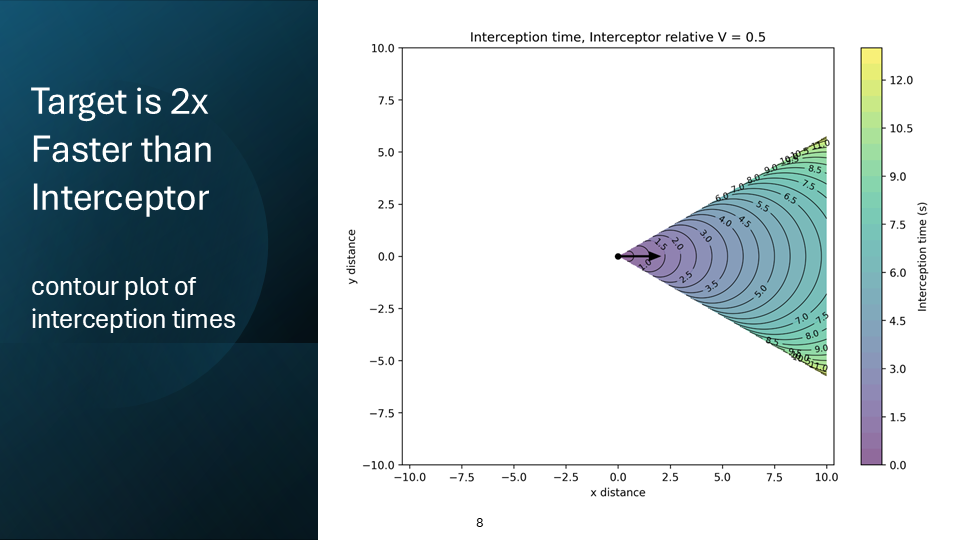
When the Target Is Twice as Fast
Examines the more extreme case in which the target is twice as fast as the interceptor, a configuration not included in the later training simulations. Interception is possible only from a narrow cone ahead of the target, using a head-on trajectory; starting behind offers no solution because the interceptor cannot catch up. The example demonstrates that slower interceptors can still engage faster targets if correctly positioned, but success requires highly accurate guidance and control at high closing speeds.