Deep Reinforcement Learning for Air-Defence Interception
This presentation examines whether Deep Reinforcement Learning can enable an air-defence interceptor to develop its own interception strategies. It first frames interception as a pursuit problem and explains how relative speed, agility, geometry and precision affect feasible approaches. It then introduces Deep-RL, in which a neural-network policy learns from observations, actions, rewards and penalties. A PPO-based agent is trained in a two-dimensional simulation to control missile thrust and detonation under noisy, slowly updated inputs. Two interceptor configurations are compared against a Mach 1 target: a Mach 1 “slow” missile and a Mach 2 “fast” missile, both limited to 10g acceleration. After training, the slow missile learns to aim ahead and intercept approximately sideways, while the fast missile passes the target, turns and attacks from behind to reduce relative velocity. Both achieve 100% success in the presented simulated tests. The presentation concludes that learned strategies depend strongly on relative capabilities and that realistic environments, evasive-target modelling and operational telemetry could support further development.
An Interceptor That Learns from Experience
Introduces the second section, which considers how an interceptor can learn from its own experience rather than rely on fixed, manually designed guidance logic. Deep Reinforcement Learning is presented as the technique used to create this adaptive control capability.
AI-Controlled Thrust and Detonation
Explains the alternative to manually constructing and optimising interception strategies. A Deep-RL agent controls the missile’s thrust vector and detonation command, learning how to use both through repeated interaction with its environment. The behaviour learned by the agent is called a policy. This arrangement allows the AI to develop interception strategies from experience instead of being required to follow a predefined direct-pursuit or predictive-pursuit method.
An Updatable AI-Based Solution
Describes the potential adaptability of an AI-based interceptor control system. Because its control logic is learned rather than permanently hard-wired, it can be retrained and updated. Initial training occurs in simulation, while telemetry from later interceptions could be returned to the training environment to refine the policy. Target evasion could also be modelled, allowing the agent in principle to learn counter-tactics for the broader pursuit-evasion problem. These are proposed extensions rather than results demonstrated in the current examples.
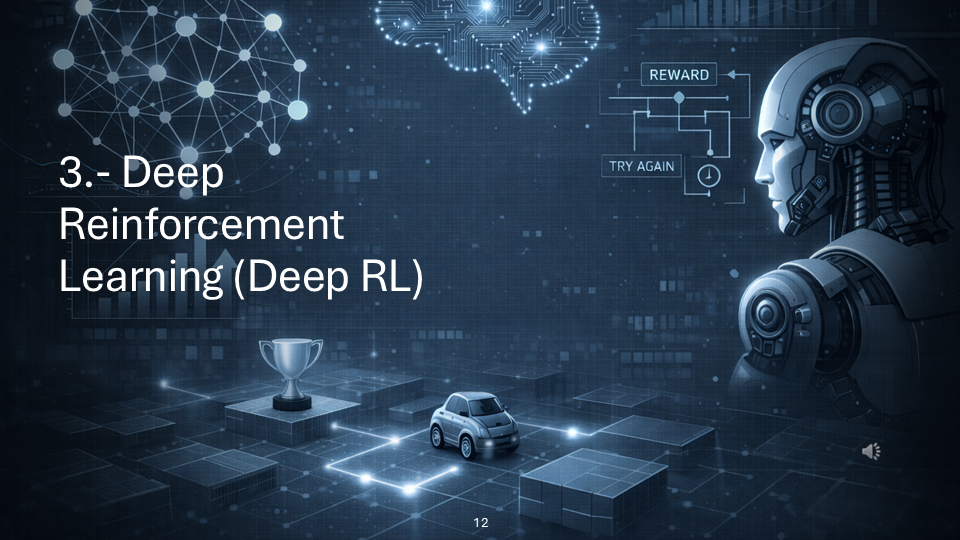
Deep Reinforcement Learning
Begins the section explaining Deep Reinforcement Learning, the AI method used for the interception experiments. The section provides the conceptual background needed to understand how an agent learns a policy from rewards and interactions with an environment.
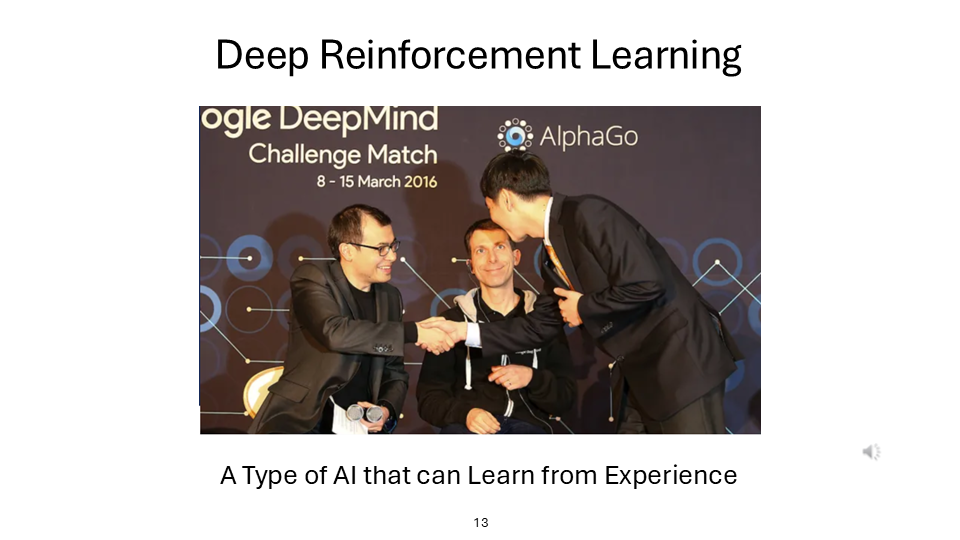
AlphaGo as an Example of Deep-RL
Uses DeepMind’s AlphaGo challenge match as an example of Deep Reinforcement Learning learning from experience and environmental interaction. The discussion identifies DeepMind co-founder Demis Hassabis and computer scientist David Silver and notes applications extending from games to robotics. The interceptor uses related algorithmic ideas. The slide also argues that the United Kingdom and Europe should retain strategically important technology companies and develop a more independent technological and military-industrial base.
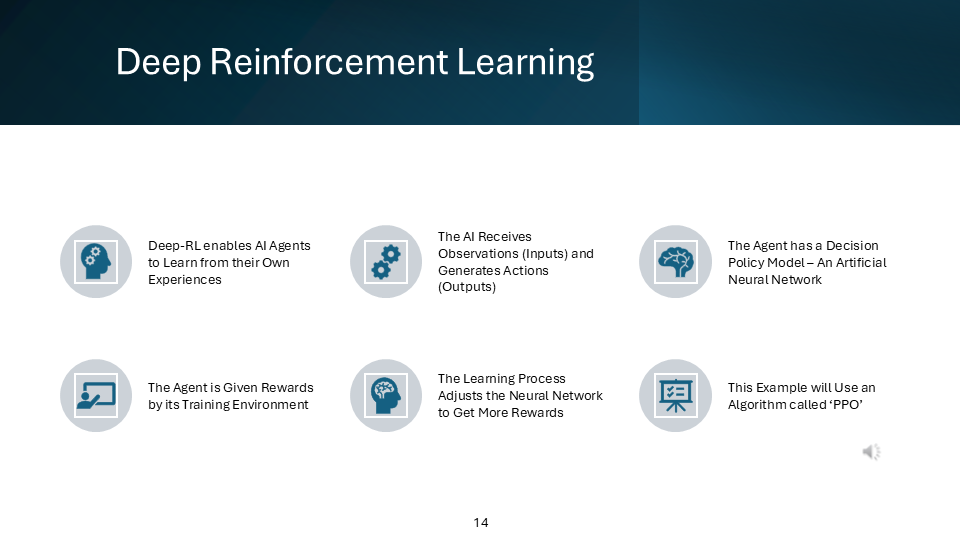
How a Deep-RL Agent Learns
Summarises the Deep-RL learning loop. An agent receives observations from its environment, and an artificial neural network serving as its policy model converts those inputs into actions. The environment supplies numerical rewards, and training adjusts the network so that the agent selects actions expected to earn greater rewards and better achieve its goal. The interceptor experiments use a learning method based on PPO, or Proximal Policy Optimisation.
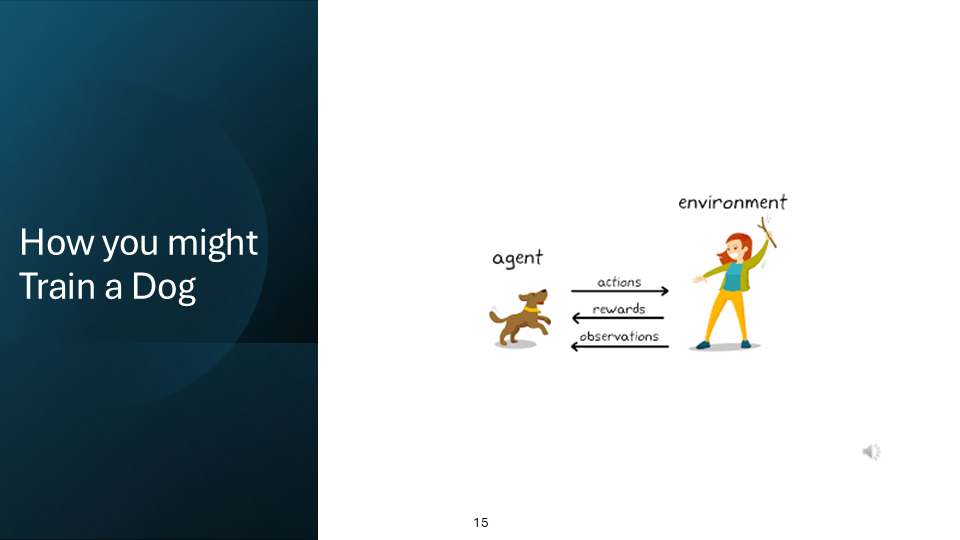
The Fetch Analogy: Observations, Actions and Rewards
Uses teaching a dog to fetch as an analogy for reinforcement learning. The dog observes the person and surrounding environment, chooses actions after seeing the stick thrown, and receives a reward for retrieving and returning it. Through repeated experience, the association between observations, actions and rewards produces the desired behaviour. The example provides an intuitive model for the same interaction cycle later applied to an artificial agent.
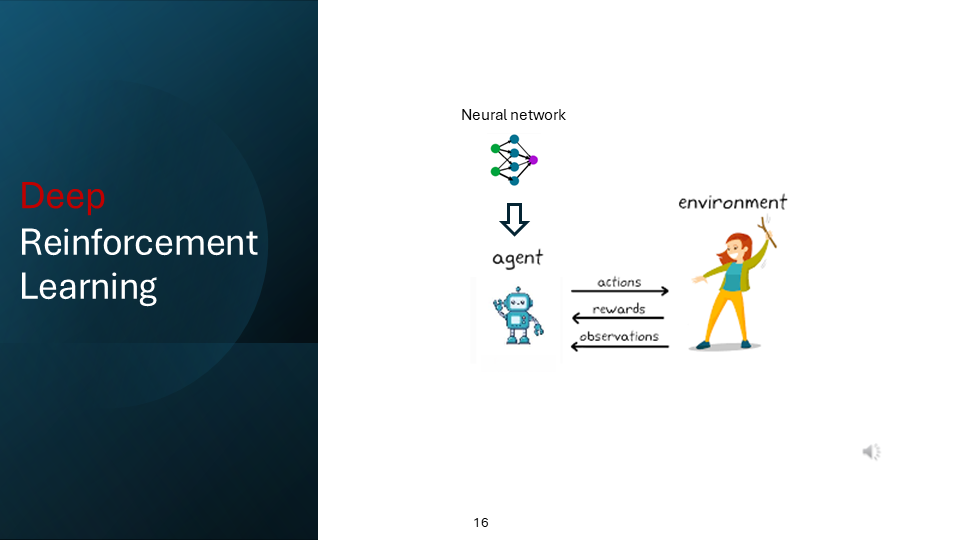
From Reinforcement Learning to Deep-RL
Maps the dog-training analogy onto Deep Reinforcement Learning. An AI agent receives environmental observations, including sensor data for a physical robot, and its neural-network policy selects actions. Success produces a numerical reward, which an optimisation process seeks to maximise. During training, the network’s parameters are adjusted so that its outputs increasingly lead to effective actions. The neural network therefore functions as the learned decision model connecting the agent’s state and observations to its behaviour.