Deep Reinforcement Learning for Air-Defence Interception
This presentation examines whether Deep Reinforcement Learning can enable an air-defence interceptor to develop its own interception strategies. It first frames interception as a pursuit problem and explains how relative speed, agility, geometry and precision affect feasible approaches. It then introduces Deep-RL, in which a neural-network policy learns from observations, actions, rewards and penalties. A PPO-based agent is trained in a two-dimensional simulation to control missile thrust and detonation under noisy, slowly updated inputs. Two interceptor configurations are compared against a Mach 1 target: a Mach 1 “slow” missile and a Mach 2 “fast” missile, both limited to 10g acceleration. After training, the slow missile learns to aim ahead and intercept approximately sideways, while the fast missile passes the target, turns and attacks from behind to reduce relative velocity. Both achieve 100% success in the presented simulated tests. The presentation concludes that learned strategies depend strongly on relative capabilities and that realistic environments, evasive-target modelling and operational telemetry could support further development.
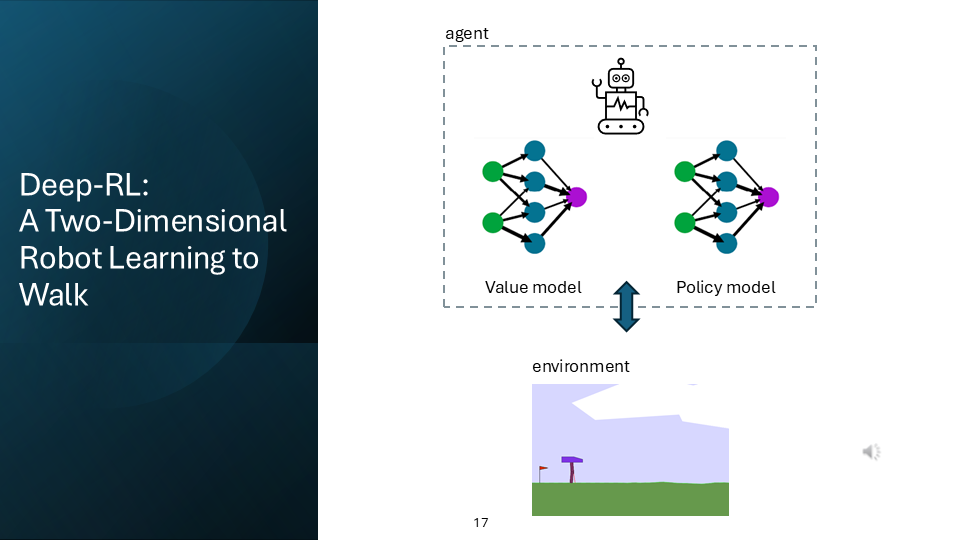
PPO Example: A Robot Learning to Walk
Illustrates PPO with Gymnasium’s Bipedal Walker v3 environment, where a two-dimensional robot learns to walk. The policy network, or actor, selects joint torques from joint positions and velocities, while the value model, or critic, estimates expected outcomes. PPO limits the size of policy updates to improve learning stability. Rewards and penalties evaluate performance, and an optimiser adjusts network weights. The example shown is from early training, when the robot remains unstable.
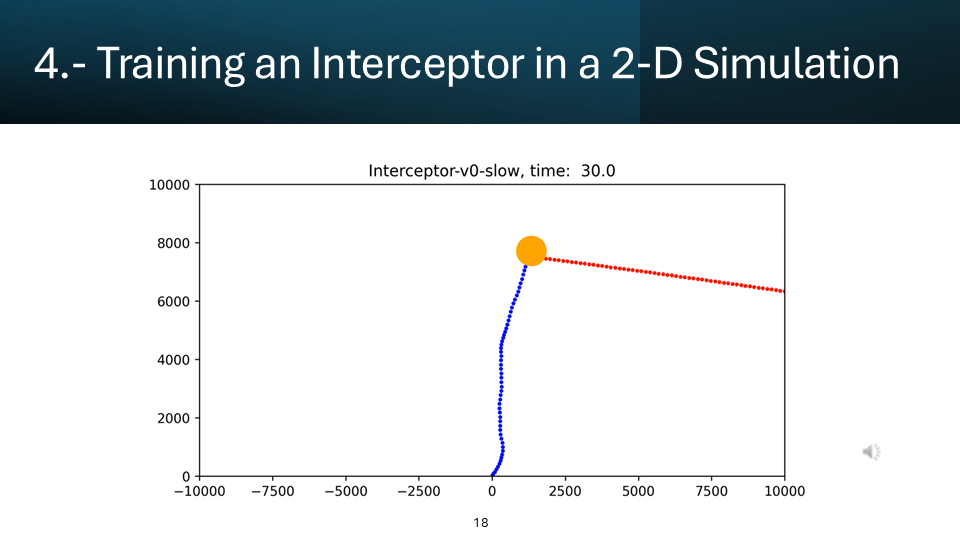
Training an Interceptor in a 2-D Simulation
Introduces the two-dimensional simulation used to train the interceptor. The target follows a predetermined curved trajectory, while the interceptor alone is controlled by an AI agent. This “smart interceptor, dumb target” setup isolates the agent’s ability to learn guidance and detonation behaviour before considering a more complex pursuit-evasion scenario in which the target also reacts.
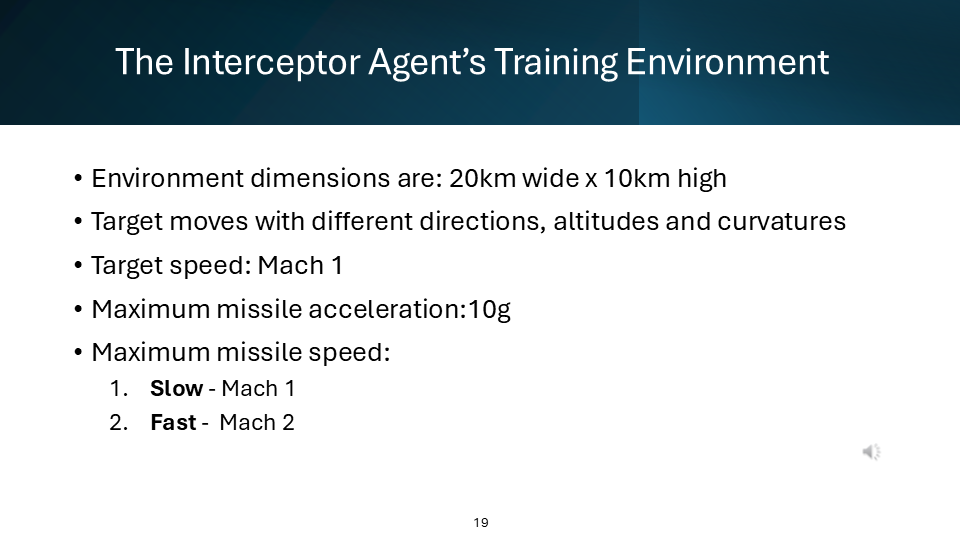
Interceptor Training Environment and Missile Configurations
Specifies the training environment and the two performance scenarios. The simulated area is 20 kilometres wide and 10 kilometres high. A Mach 1 target follows trajectories with varied directions, altitudes and curvatures. The interceptor is limited to 10g acceleration and is tested with either a Mach 1 maximum speed, equal to the target, or a Mach 2 maximum speed, twice the target’s. These deliberately constrained configurations require the AI to compensate for performance limitations through strategy.
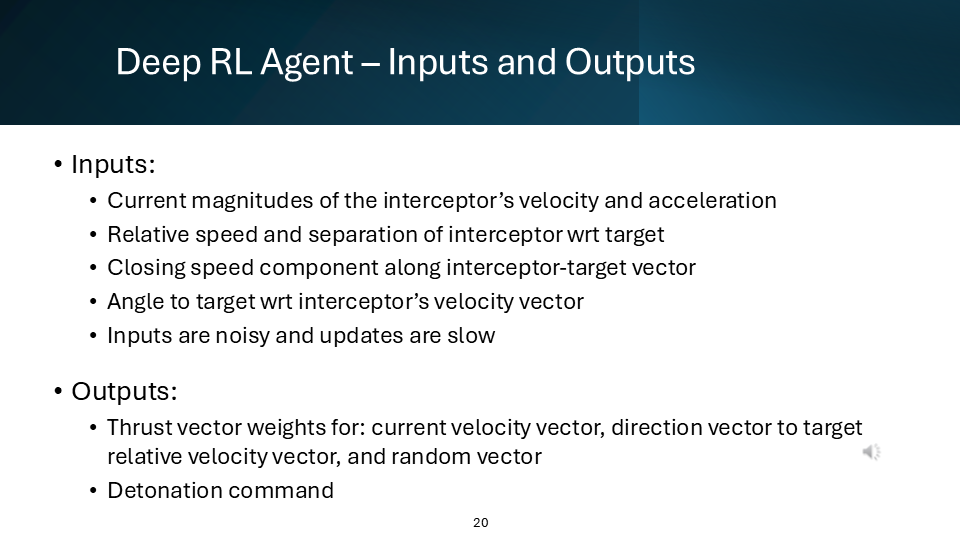
Deep-RL Policy Inputs and Outputs
Defines the policy model’s observations and controls. Scalar inputs describe interceptor speed and acceleration, target-relative speed and separation, closing speed along the connecting direction, and the angle between interceptor velocity and the target direction. Measurements are noisy and updated slowly, requiring the policy to handle imperfect and slightly outdated information. Outputs include a detonation command and weights used to construct a magnitude-limited thrust vector from current velocity, target direction, relative velocity and a random unit-vector component.
Training Rewards, Penalties and Probabilistic Success
Explains the reward design that guides learning. Destroying the target earns a large reward, with only a small bonus for doing so quickly, making successful interception more important than speed. Failed attempts can still earn a smaller reward based on closest approach, helping the agent first learn to reduce separation. Penalties apply for missing, striking the ground or allowing the target to leave the area. At detonation, success probability is based on separation: it is 100% at zero distance and declines to zero with increasing distance.
Fast Missile Performance Early in Training
Shows the Mach 2 interceptor early in training. Only one of four attempted interceptions succeeds. The missile generally travels toward the target in an approximately straight line, indicating that the policy has learned some relevant behaviour, but it does not yet select an effective interception point. The result demonstrates an intermediate stage in which the agent has improved beyond unguided behaviour but remains unable to achieve the objective consistently.
Interception Strategies After Training
Introduces the comparison of the final strategies learned after training. The following examples contrast the Mach 1 interceptor, whose maximum speed equals the target’s, with the Mach 2 interceptor, which has a substantial speed advantage.
Slow Missile: Predictive Side-On Interception
Shows the trained policy for the “slow” Mach 1 missile against a Mach 1 target. Because the interceptor can neither catch the target from behind nor outrun it, the agent aims ahead and estimates a future interception point. It approaches at roughly 90 degrees to the target’s direction of travel, and a miss would leave little chance of re-engagement. Despite the need for accurate prediction and the high crossing geometry, the policy achieves a reported 100% success rate in the presented simulated test scenarios.