Artificial Swarm Intelligence for Autonomous Systems and Drones
This presentation explains artificial swarm intelligence and its proposed application to autonomous and semi-autonomous unmanned systems. It begins with biological examples—starling murmurations, ant colonies, and cellular automata—to show how complex collective behaviour can emerge from simple local rules. It then places collaborative autonomy within a four-stage model of unmanned-system development and argues that decentralised swarms could offer cooperation, resilience, and no single point of failure. The technical section outlines a “Swarm AI” approach based on simple agents, limited local sensing, constructive pseudorandom behaviour, modified deep reinforcement learning, evolutionary optimisation, reward shaping, and cooperation factors. Simulations demonstrate grid searching, a self-healing communications repeater chain, a deconflicted point-target attack, a synchronised distributed thermobaric scenario, and cooperation between designator and attack drones against moving targets. The principal conclusion is that appropriately designed and trained simple agents can develop their own robust collective strategies, although those strategies may not always be intuitively understandable to humans.
Artificial Swarm Intelligence, Autonomous Systems and Drones
Introduces a shortened presentation on artificial swarm intelligence for autonomous and semi-autonomous robotic systems, particularly drones. The central idea is that many simple AI agents can cooperate to produce effective collective behaviour without relying on one complex controller. The approach is inspired more by insect colonies than human intelligence and does not merely copy natural swarming. The presentation will show simulations involving battlefield communications and several forms of coordinated drone attack developed through work undertaken in Ukraine in 2024.
Short and Full Versions of the Talk
Explains that this approximately 40-minute presentation is a concise version of a longer, 90-minute talk. The full version provides additional background on biological intelligence, artificial intelligence, emergent behaviour, and deep reinforcement learning, while the shorter version moves directly to the principal concepts and simulations. A web address is provided for viewers seeking the more detailed treatment.
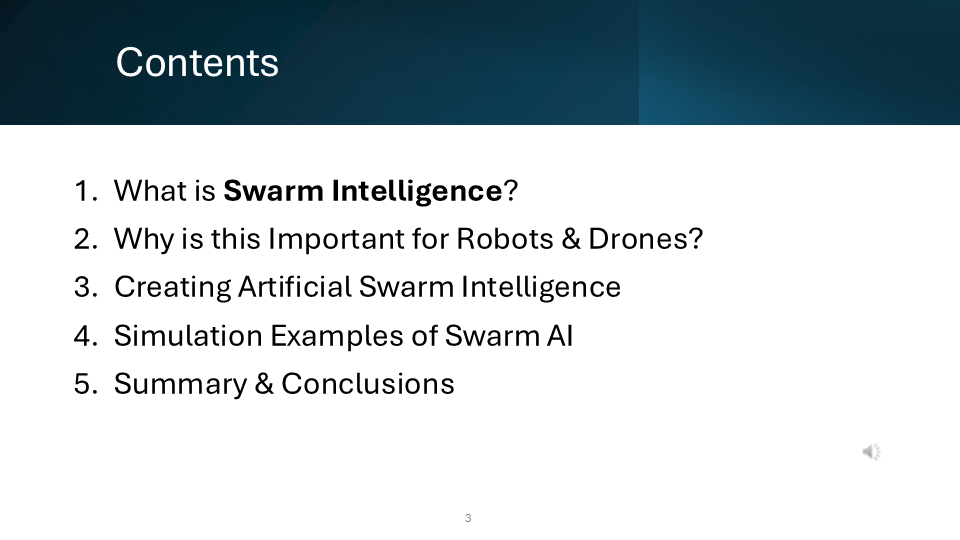
Presentation Contents
Outlines the presentation’s five-part structure: defining swarm intelligence; explaining its relevance to robots and drones; describing how artificial swarm intelligence was created; demonstrating its performance in simulations; and summarising the conclusions. The simulation section will cover constructive pseudorandom behaviour, a dynamic communications repeater chain, and three autonomous swarm-attack scenarios requiring deconfliction or synchronisation.
What Is Swarm Intelligence in Nature?
Opens the first section, which examines the meaning of swarm intelligence in nature and establishes the biological and scientific concepts used throughout the presentation.
Collective Intelligence and Emergent Behaviour
Defines swarm intelligence as complex, apparently intelligent collective behaviour produced by many individually limited creatures. Birds may move in coordinated groups, while ant colonies achieve success through cooperation and remain resilient when individual members are lost. This differs from intelligence centred on an individual’s capabilities, as in humans. The ability of simple agents to achieve complex goals collectively is introduced as an example of emergent behaviour and as a concept relevant to drone systems.
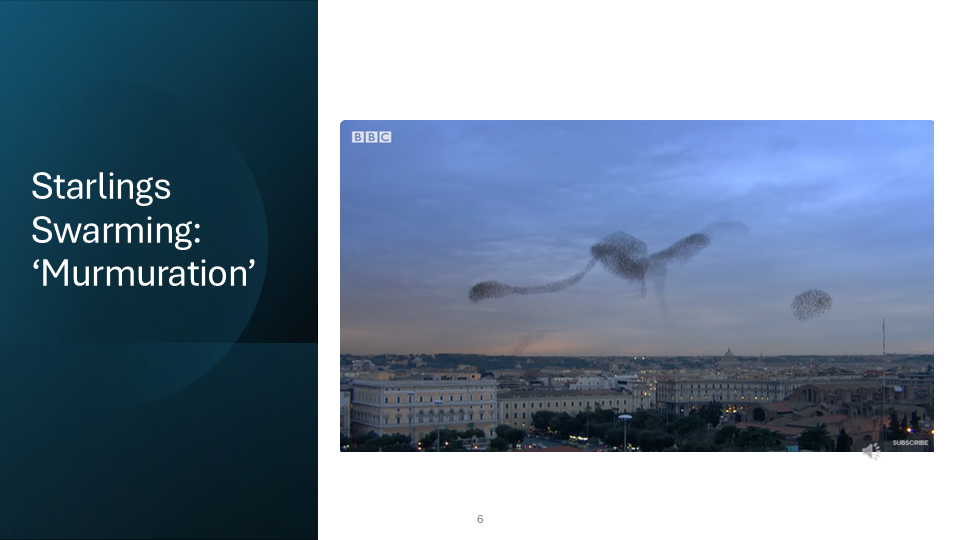
Starling Murmurations and Simple Local Rules
Uses a starling murmuration over Rome to illustrate how complex three-dimensional group movement can arise from simple local rules. Models can reproduce such behaviour when each bird maintains separation, moves toward the centre of nearby birds, and aligns its velocity with theirs. The example supports a central theme: sophisticated collective patterns can emerge without central coordination when many individuals follow a limited set of rules, although the biological behaviour itself is presented as an evolved survival adaptation.
Emergence in a Cellular Automaton
Introduces emergence through the cellular automaton “Brian’s Brain,” devised by Brian Silverman in 1984. Each cell on a grid changes state according only to neighbouring cells, yet complicated large-scale patterns appear. The example distinguishes self-organisation from chaotic instability and defines emergent behaviour as complex system-level activity that is not apparent from the simple rules followed by individual components. Such outcomes arise from the mathematics but may be difficult to predict or understand intuitively.
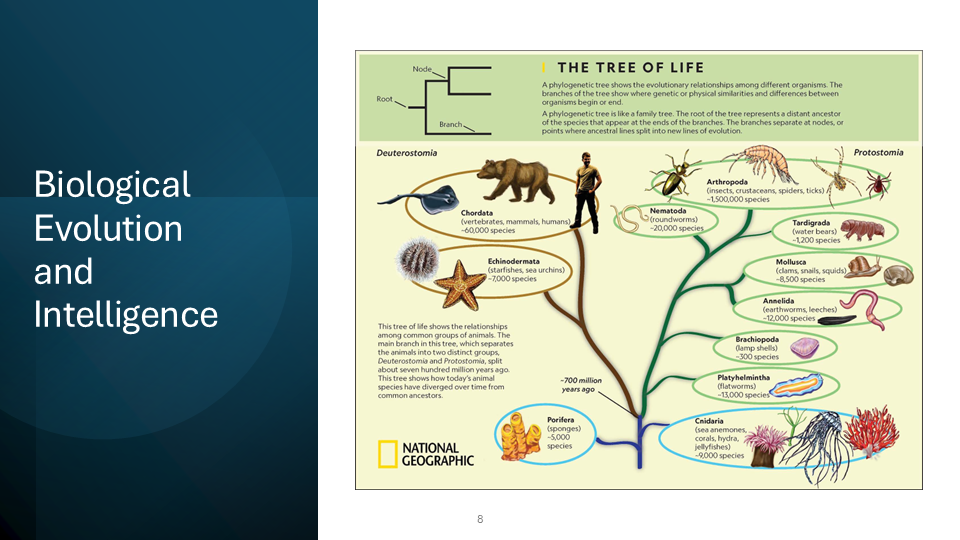
Biological Evolution and Alternative Forms of Intelligence
Uses a simplified tree of life to contrast the evolutionary branch leading to vertebrates and humans with the branch leading to insects and related animals, separated roughly 700 million years ago. The presentation argues that human intelligence should not automatically be treated as evolution’s only successful strategy. It cites estimates of more than one billion insects per human and greater total insect biomass to suggest that insects may be considered highly successful in evolutionary terms.