Artificial Swarm Intelligence, Autonomous Systems and Drones
This presentation examines artificial swarm intelligence for autonomous and semi-autonomous robotic systems, with particular emphasis on drones. It develops the idea that complex, resilient collective behaviour can emerge from cooperation between relatively simple AI agents, drawing on natural swarm intelligence, emergent behaviour and biological evolution. It then outlines a Swarm AI design trained using modified deep reinforcement learning and evolutionary optimisation, before demonstrating the approach in simulations of grid search, a self-healing communications repeater chain and three forms of coordinated autonomous swarm attack.
What We Have Seen
The preceding examples are brought together: starling flocking, scientific emergence and biological evolution all show that complex collective behaviour can arise from simple local rules. The difficulty is that desired group behaviour is hard to design directly, motivating the use of learning methods to discover suitable strategies.
Why is this Important for Drones & Robotics?
The presentation now turns from biological and scientific examples to the relevance of swarm intelligence for military drones and robotic systems.
The Impact of New Technologies
The war in Ukraine is used to illustrate the rapid development of unmanned systems and AI-enabled capabilities. Drones increasingly use AI for functions such as maintaining flight after communications loss and locating or identifying targets with reduced human control.
Four Stages of UxV Evolution
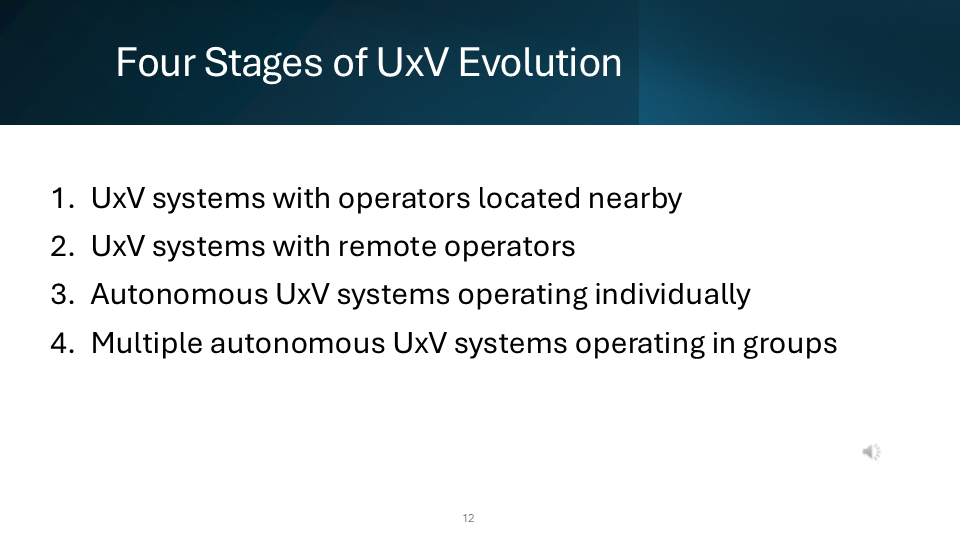
UxV development is described in four stages: nearby human control, remote human control, independent autonomous operation and collaborative autonomous operation. The presentation focuses on the fourth stage, where multiple autonomous systems cooperate and develop collective strategies.
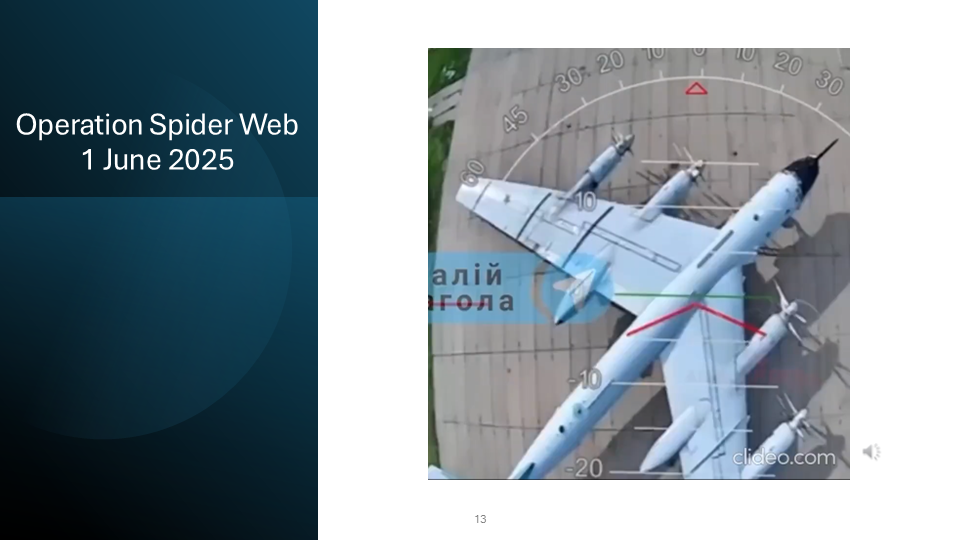
Operation Spider Web
Operation Spider Web on 1 June 2025 is discussed as an example of a long-range Ukrainian drone attack against Russian military airfields. The narration considers possible AI-assisted target recognition and presents the operation as an intermediate step toward increasingly autonomous unmanned systems.
Moving Beyond These Capabilities
Swarm intelligence offers a possible route beyond individually autonomous systems. A group of relatively simple UxVs could cooperate without a central coordinator, avoiding a single point of failure and remaining resilient to losses, but the required individual control rules are difficult for humans to design directly.
Creating Artificial Swarm Intelligence
The third section introduces the method used to create a distributed artificial intelligence referred to as Swarm AI. The following slides give a concise overview of its design and training.
Creating Artificial Swarm Intelligence
The proposed Swarm AI uses relatively simple agents with limited sensory information, local awareness and the ability to exploit pseudorandom behaviour constructively. Training combines modified deep reinforcement learning with evolutionary optimisation so that effective collective strategies can be learned rather than explicitly programmed.