Artificial Swarm Intelligence, Autonomous Systems and Drones
This presentation examines artificial swarm intelligence for autonomous and semi-autonomous robotic systems, with particular emphasis on drones. It develops the idea that complex, resilient collective behaviour can emerge from cooperation between relatively simple AI agents, drawing on natural swarm intelligence, emergent behaviour and biological evolution. It then outlines a Swarm AI design trained using modified deep reinforcement learning and evolutionary optimisation, before demonstrating the approach in simulations of grid search, a self-healing communications repeater chain and three forms of coordinated autonomous swarm attack.
Swarm Repeater Simulation
The repeater simulation shows the swarm maintaining communications despite substantial losses. Surviving drones automatically reconfigure into a self-healing, redundant chain, demonstrating resilience and effective collective behaviour based mainly on local information.
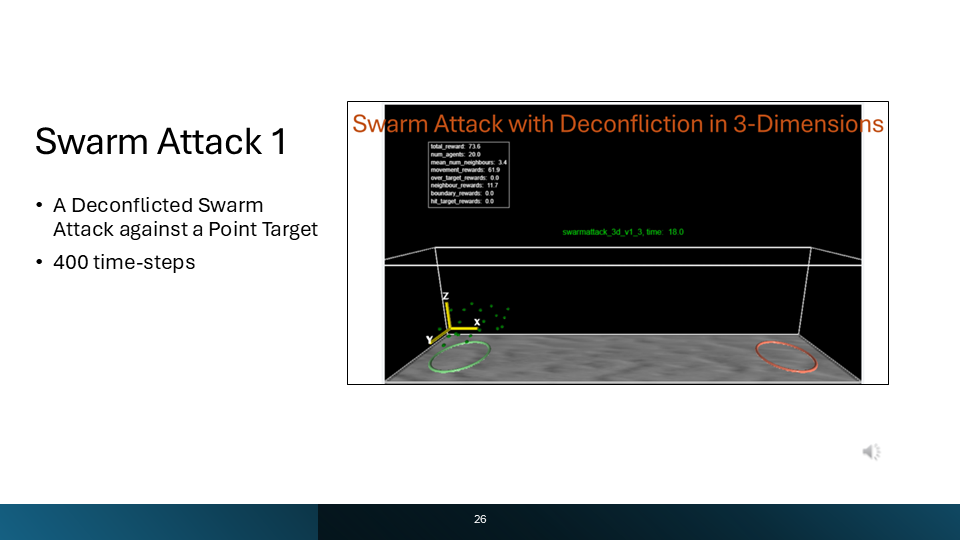
Swarm Attack 1
The first swarm-attack scenario targets a static point. Drones approach, loiter and attack while coordinating their detonations so that one attack does not destroy other members of the swarm; this coordination problem is described as deconfliction.
Swarm Attack 1 Simulation
The simulation shows the swarm approaching in formation, dispersing above the target and attacking sequentially without destructive interference between agents. Simple drones with minimal sensors and small neural networks nevertheless execute a coordinated, deconflicted attack and destroy the target.
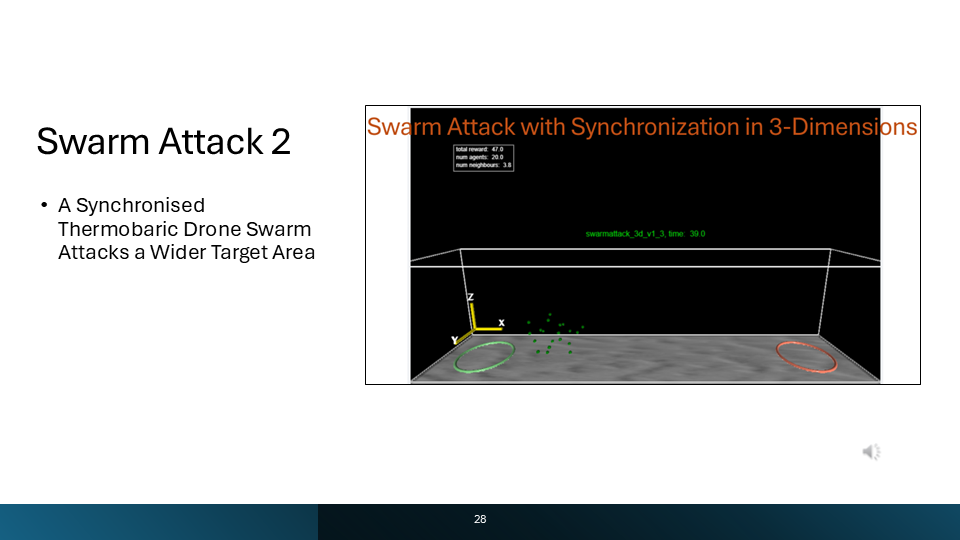
Swarm Attack 2
The second attack scenario explores a synchronised distributed thermobaric attack over a wider target area. The concept requires multiple drones to cooperate in releasing an explosive aerosol and then detonating it at the appropriate time.
Swarm Attack 2 Simulation
In the simulation, the swarm approaches the target area, arms its weapons, releases explosive aerosol and waits until the required cloud density is reached before detonation. The sequence illustrates coordinated timing across the swarm.
Swarm Attack 3
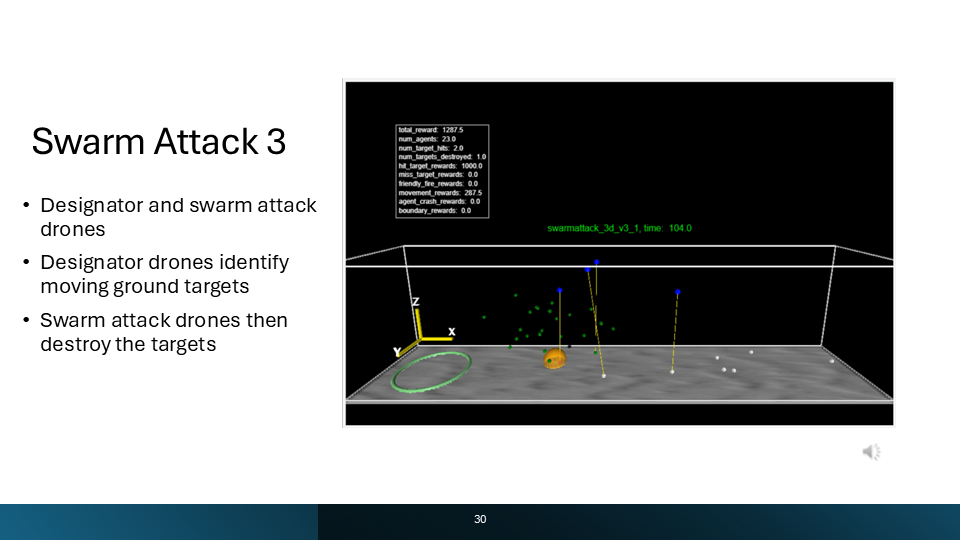
The third scenario uses two cooperating drone types against several moving ground targets. Target-designation drones find and illuminate targets with infrared lasers, while autonomous attack drones detect the designated targets and move to engage them.
Swarm Attack 3 Simulation
The simulation shows target-designation drones tracking and illuminating moving ground targets while attack drones engage them. The attacking swarm also coordinates its strikes to avoid interference, and all targets are rapidly located and destroyed.

Summary & Conclusions
The final section asks which ideas from the presentation are most important and introduces the concluding summary.