Artificial Swarm Intelligence for Autonomous Systems and Drones
This presentation explains artificial swarm intelligence and its proposed application to autonomous and semi-autonomous unmanned systems. It begins with biological examples—starling murmurations, ant colonies, and cellular automata—to show how complex collective behaviour can emerge from simple local rules. It then places collaborative autonomy within a four-stage model of unmanned-system development and argues that decentralised swarms could offer cooperation, resilience, and no single point of failure. The technical section outlines a “Swarm AI” approach based on simple agents, limited local sensing, constructive pseudorandom behaviour, modified deep reinforcement learning, evolutionary optimisation, reward shaping, and cooperation factors. Simulations demonstrate grid searching, a self-healing communications repeater chain, a deconflicted point-target attack, a synchronised distributed thermobaric scenario, and cooperation between designator and attack drones against moving targets. The principal conclusion is that appropriately designed and trained simple agents can develop their own robust collective strategies, although those strategies may not always be intuitively understandable to humans.
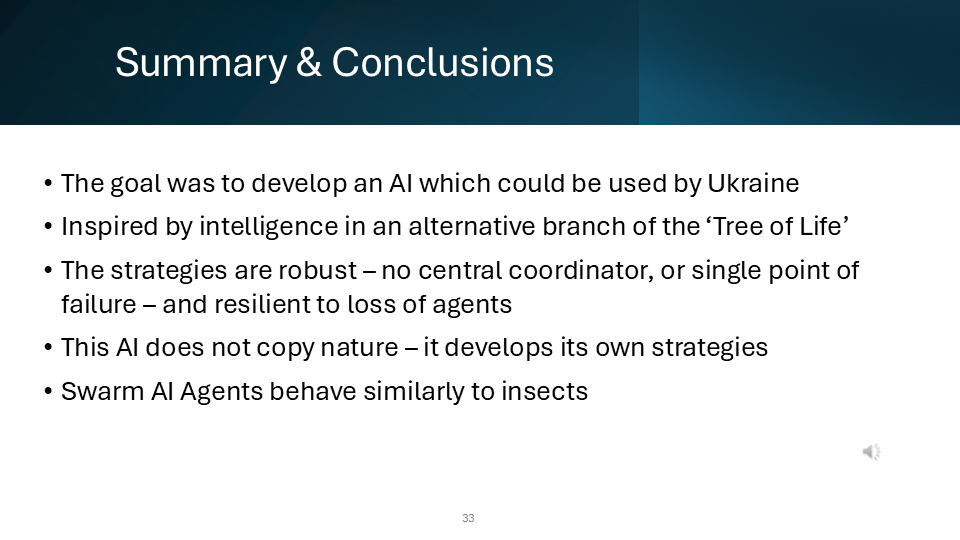
Principal Findings on Swarm AI
Concludes that the project sought to develop advanced AI for autonomous unmanned systems, including potential use by Ukraine. The approach draws inspiration from insect-like collective intelligence rather than human cognition. Simple agents are designed and trained to develop their own cooperative strategies, potentially involving emergence. Because there is no central coordinator, the resulting systems have no single control point whose loss would disable the whole swarm and can remain effective after losing individual agents. Their insect-like behaviour is intentional, but their strategies are learned rather than copied directly from nature.
Closing Remarks from Kyiv
Closes the presentation with thanks and situates its preparation in Kyiv during a winter marked by frequent Russian drone and missile attacks. It describes difficult conditions in Ukraine, including attacks on infrastructure and extended civilian outages of electricity, heating, and water during severe cold. The final remarks express the presenter’s personal belief that Russia and its leadership will ultimately face consequences for their actions, framed through the saying, “You will reap what you sow.”