Artificial Swarm Intelligence, Autonomous Systems and Drones
This presentation examines artificial swarm intelligence for autonomous and semi-autonomous robotic systems, with particular emphasis on drones. It develops the idea that complex, resilient collective behaviour can emerge from cooperation between relatively simple AI agents, drawing on natural swarm intelligence, emergent behaviour and biological evolution. It then outlines a Swarm AI design trained using modified deep reinforcement learning and evolutionary optimisation, before demonstrating the approach in simulations of grid search, a self-healing communications repeater chain and three forms of coordinated autonomous swarm attack.
Artificial Swarm Intelligence, Autonomous Systems and Drones
This short presentation introduces artificial swarm intelligence for autonomous and semi-autonomous robotic systems, including drones. It explains an approach in which many relatively simple AI agents cooperate to develop collective strategies, with examples including battlefield communications and several forms of autonomous swarm attack.
The Full Version of this Talk
The slide points to a longer version of the talk, approximately 90 minutes in length, containing additional background on biological intelligence, artificial intelligence, emergent behaviour and deep reinforcement learning. This shorter version focuses more directly on the main ideas and simulations.
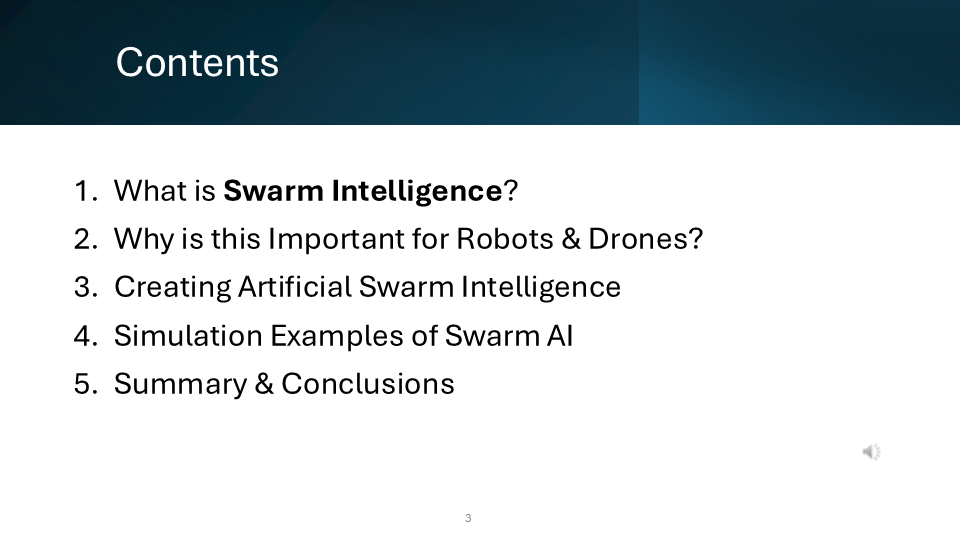
Contents
The talk is organised into five sections: swarm intelligence in nature; its relevance to drones and robotics; the creation of artificial swarm intelligence; simulation examples; and conclusions. The simulations include grid search, a dynamic communications repeater chain and three autonomous swarm attacks.
What is Swarm Intelligence in Nature?
The first section introduces the central question of what swarm intelligence is and how forms of collective intelligence observed in nature can help motivate artificial systems.
What is Swarm Intelligence?
Swarm intelligence is introduced through natural examples in which collective success depends on cooperation between many limited individuals. Ant colonies illustrate how complex and apparently intelligent group behaviour can emerge without requiring highly capable individual members.
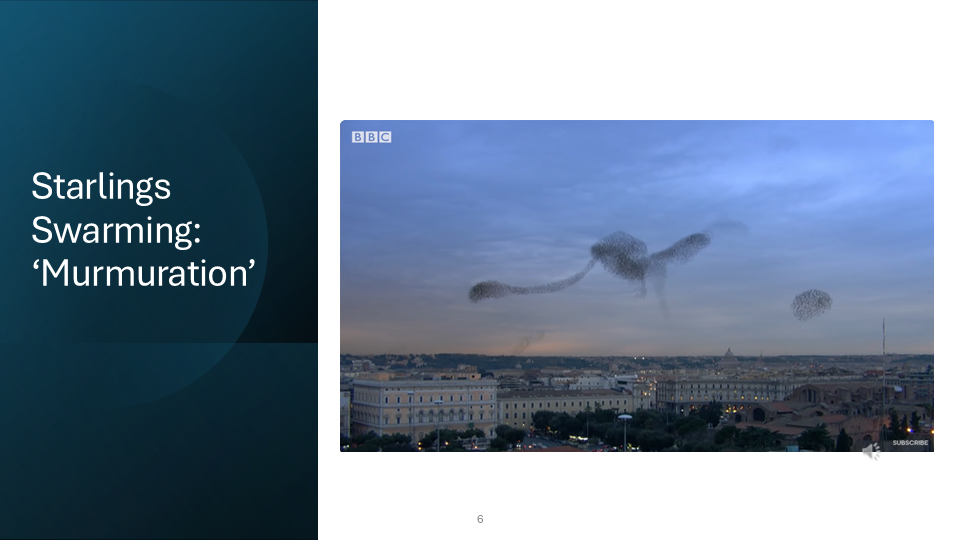
Starlings Swarming: Murmuration
A starling murmuration demonstrates how complex three-dimensional flocking can arise from simple local rules such as separation, cohesion and alignment. The example establishes the key idea that sophisticated group behaviour can emerge from many simple agents acting on limited local information.
Emergence: Brian's Brain
Brian's Brain, a cellular automaton, illustrates emergent behaviour. Each cell follows a simple local update rule, yet complex and difficult-to-predict large-scale patterns develop spontaneously, showing how simple component interactions can generate organised global behaviour.
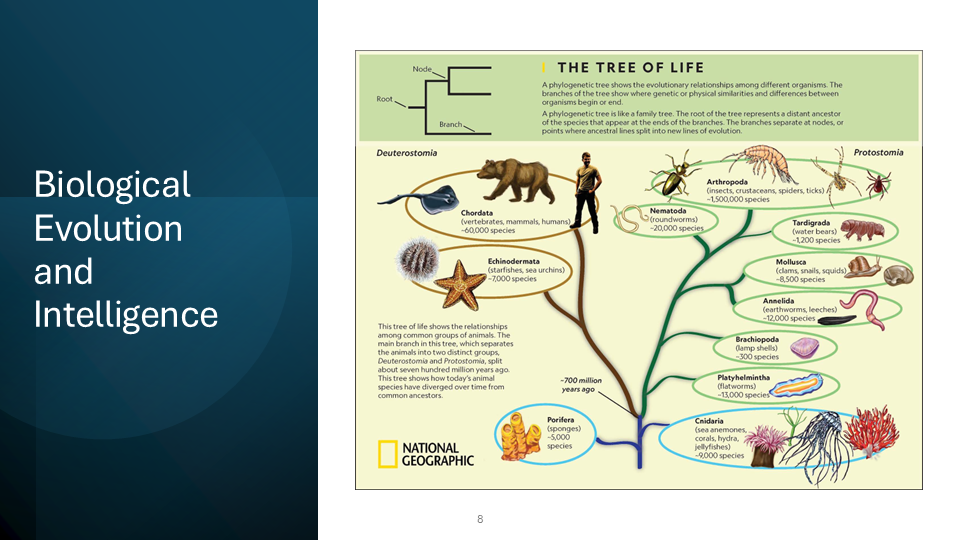
Biological Evolution and Intelligence
A simplified tree of life is used to contrast different evolutionary strategies. The discussion argues that intelligence based on highly capable individuals is only one route to success, while insects demonstrate the effectiveness of collective strategies based on very large numbers of simpler organisms.