Artificial Swarm Intelligence for Autonomous Unmanned Systems
This presentation explains how artificial swarm intelligence could enable groups of relatively simple autonomous agents to solve complex problems collaboratively. It begins with the rapid development of unmanned systems in the war in Ukraine, then draws on biological evolution, natural swarms and emergence to show how sophisticated collective behaviour can arise from local rules without a central coordinator. A technical introduction to deep reinforcement learning covers policies, rewards, PPO and the importance of realistic training environments and carefully designed incentives. The final section presents swarm agents designed with limited sensors, small neural networks and short-range awareness, trained through modified reinforcement learning and evolutionary methods. Two- and three-dimensional simulations demonstrate grid search, obstacle traversal, continuous swarm movement, a resilient communications repeater chain, and coordinated attacks involving deconfliction, synchronisation and moving targets. The central conclusion is that appropriately trained simple agents can develop their own robust collective strategies, with natural redundancy and no single point of failure.
Artificial Swarm Intelligence, Autonomous Systems and Drones
Introduces a technical examination of artificial swarm intelligence for drones and other unmanned robotic systems. The central idea is that many simple AI agents can cooperate to produce complex collective behaviour rather than relying on one highly capable controller. The presentation will build the necessary background, explain the learning methods, and conclude with simulations of collaborative drone operations and attacks. A recurring distinction is that the agents learn tactics suited to their goals; they do not merely imitate tightly grouped natural swarms.
What Is Artificial Swarm Intelligence?
Defines artificial swarm intelligence as coordinated action by many simple AI agents seeking a shared objective or mass effect. The concept is inspired by collective behaviour among animals and insects, but differs from prominent AI systems such as large language models. Its relevance here is to autonomous robots and unmanned UxV systems. “Swarm” refers primarily to collective behaviour: depending on the task, the agents may operate in a close formation or disperse widely.
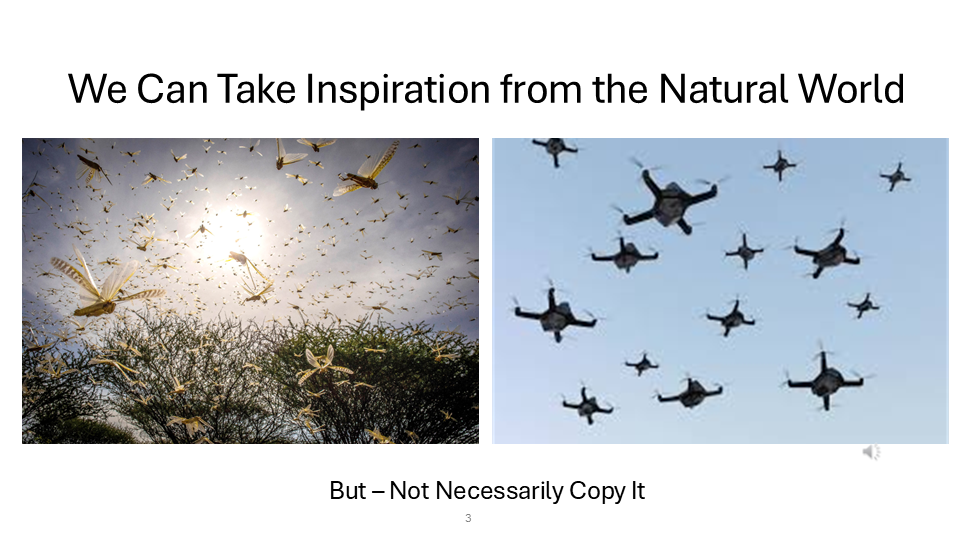
Inspired by Nature, Not Bound to Copy It
Explains that nature should provide inspiration rather than a template to copy uncritically. Natural creatures swarm in response to particular evolutionary challenges; technological systems should reproduce that behaviour only when solving a similar problem. Artificial swarm intelligence is therefore defined by agents learning to cooperate toward a goal, not by their physical formation. In some circumstances, a widely dispersed group may be more effective than a dense swarm.
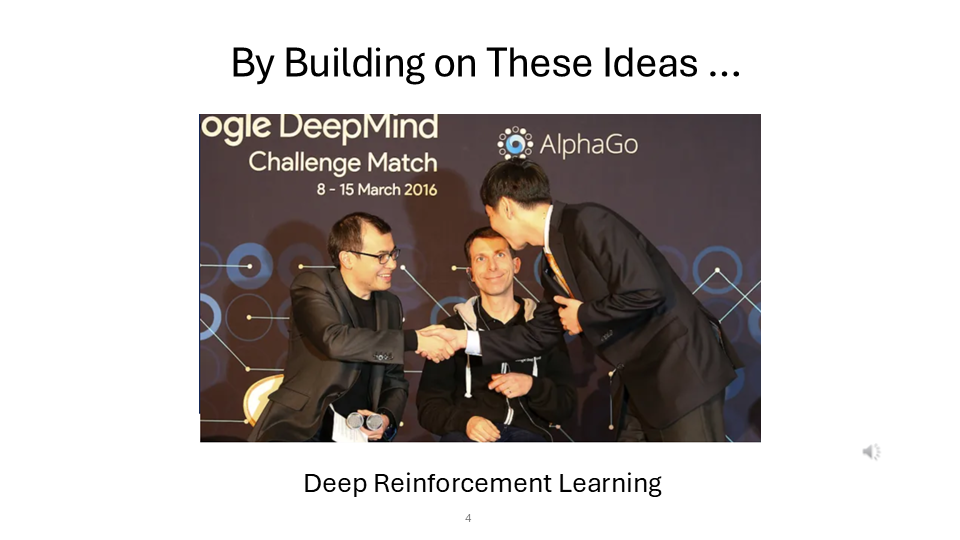
Building on Deep Reinforcement Learning
Connects the project to deep reinforcement learning through AlphaGo, which learned from experience and interaction rather than being given an explicit solution for every situation. Similar methods now extend from games to robotics and underpin the swarm technology discussed later. The slide also uses DeepMind’s history to argue that the United Kingdom and Europe should retain strategically important technology companies and develop a stronger independent technological and defence-industrial base.
Preview: Autonomous Swarm Attack on a Point Target
Previews a three-dimensional simulation in which autonomous UAVs leave a circular launch zone, travel toward a point target and detonate when close enough to attack it. The agents sustain the assault without destroying one another, demonstrating learned deconfliction. Their movements resemble those of insects, although the behaviour emerges from the AI design and training rather than being explicitly copied. The simulation is revisited later with a fuller technical explanation.
Presentation Structure and the Meaning of an AI Agent
Outlines the presentation’s three parts: background and introduction; how individual AI agents learn with deep reinforcement learning; and the developed swarm AI agents. An AI agent is defined as software with agency that observes an environment, makes decisions and takes actions affecting outcomes. Such agents can control robots or UxVs and learn through interaction. Swarm agents extend this model by learning to solve problems collectively rather than only as individuals.
Part 1 Overview: Background and Introduction
Introduces the background section. It will connect three topics: technological lessons from the war in Ukraine, the relationship between biological evolution and different forms of intelligence, and the concepts of swarm intelligence and emergence. This progression establishes why simple, locally acting entities can produce coordinated and sometimes surprising large-scale behaviour relevant to unmanned systems.
Part 2 Overview: How AI Agents Learn
Previews the single-agent learning section. It will define a behavioural policy, explain why learning one is harder than standard classification or regression, and show how an artificial neural network can learn a policy through deep reinforcement learning. A two-dimensional lunar lander simulation will illustrate the process, followed by lessons concerning training environments, reward design and the behaviour that learned policies actually produce.