Artificial Swarm Intelligence for Autonomous Unmanned Systems
This presentation explains how artificial swarm intelligence could enable groups of relatively simple autonomous agents to solve complex problems collaboratively. It begins with the rapid development of unmanned systems in the war in Ukraine, then draws on biological evolution, natural swarms and emergence to show how sophisticated collective behaviour can arise from local rules without a central coordinator. A technical introduction to deep reinforcement learning covers policies, rewards, PPO and the importance of realistic training environments and carefully designed incentives. The final section presents swarm agents designed with limited sensors, small neural networks and short-range awareness, trained through modified reinforcement learning and evolutionary methods. Two- and three-dimensional simulations demonstrate grid search, obstacle traversal, continuous swarm movement, a resilient communications repeater chain, and coordinated attacks involving deconfliction, synchronisation and moving targets. The central conclusion is that appropriately trained simple agents can develop their own robust collective strategies, with natural redundancy and no single point of failure.
Learning the Right Local Rules
Identifies the practical challenge: humans do not know how to hand-design the simple individual control rules that will reliably produce a desired collective outcome. The proposed solution is an AI deliberately designed and trained to operate more like an insect, allowing it to discover useful local rules through learning rather than requiring humans to specify the group strategy explicitly.
Part 2: Learning to Solve Problems with Deep RL
Introduces Part 2, which explains how individual agents learn behavioural policies through deep reinforcement learning. This single-agent foundation will later be extended to collaborative multi-agent systems.
Why Learning a Policy Is Difficult
Begins the discussion of policies and why they are difficult to train. The section compares policy learning with more conventional supervised tasks such as classification and regression before showing how deep reinforcement learning learns from experience.
Policies Map Observations to Actions
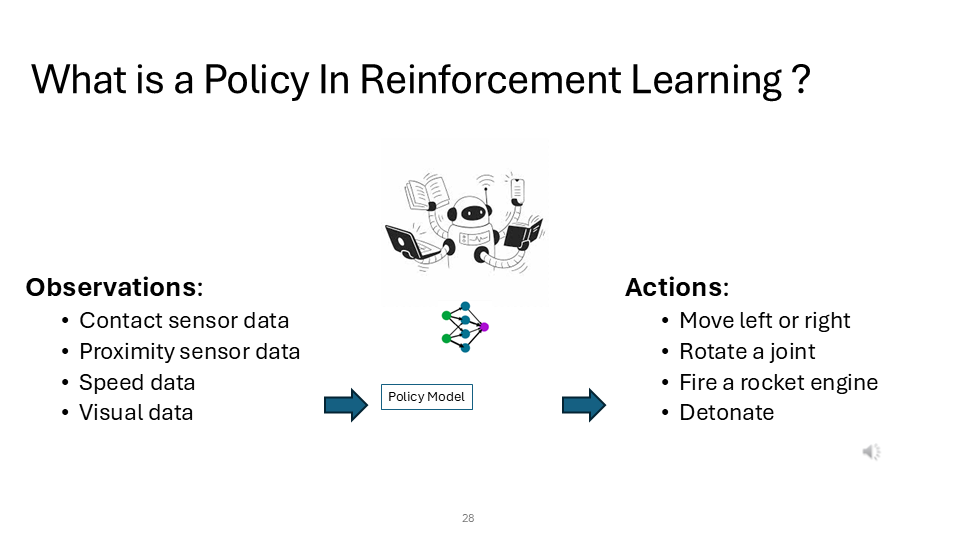
Defines a reinforcement-learning policy as the mechanism that maps observations to actions. Inputs might include contact, proximity, speed or visual data, while outputs could control movement, joints, engines or detonation. Policies often generate probability distributions rather than one fixed action, enabling an agent to balance exploration of uncertain alternatives with exploitation of actions it currently believes will perform best.
Why Policy Training Is Harder Than Supervised Learning
Explains why policy training is harder than supervised classification. In a labelled cat-versus-dog dataset, the correct answer is known for every example. For chess, Go or autonomous control, the desired final outcome may be clear, but the best action in each intermediate situation is unknown. The agent must discover those actions itself, so conventional supervised learning is insufficient. Deep reinforcement learning combines neural networks with reward-driven learning to address this problem.
How Deep RL Agents Learn from Experience
Transitions to the mechanism by which deep reinforcement-learning agents learn policies from their own experience. It also introduces Proximal Policy Optimisation, or PPO, as a widely used algorithm that will clarify the training process.
The Fetch Analogy for Reinforcement Learning
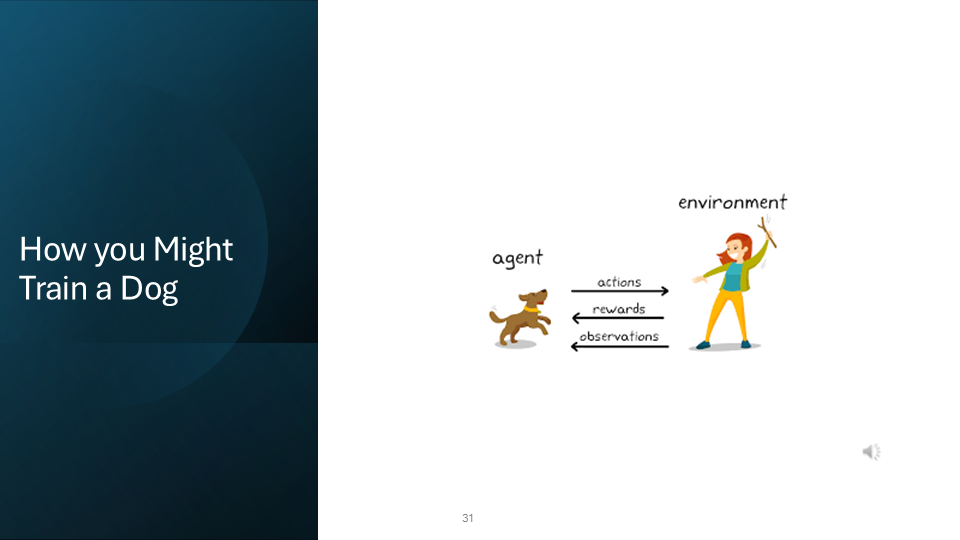
Uses training a dog to fetch as an intuitive reinforcement-learning analogy. The dog observes its environment, decides how to act, and receives a reward when it retrieves the stick. Repeated observation-action-reward cycles gradually reinforce successful behaviour. The task is relatively easy for dogs because it builds on natural instincts, but the same interaction structure applies to artificial agents.
Deep Reinforcement Learning and Reward Shaping
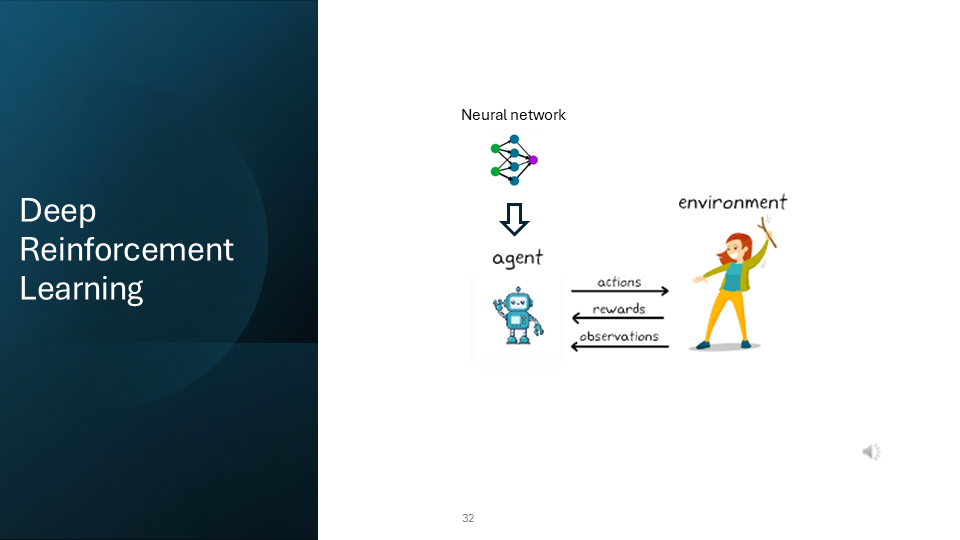
Maps the dog-training cycle to deep reinforcement learning. A neural-network policy processes observations and selects actions, while numerical rewards tell the learning algorithm whether outcomes are desirable. Reward shaping can provide intermediate feedback as well as a final reward, accelerating learning in long tasks. A tank-battle example shows how rewards for destroying opposing tanks and penalties for losses can guide learning more efficiently than only rewarding the final victory.