Artificial Swarm Intelligence for Autonomous Unmanned Systems
This presentation explains how artificial swarm intelligence could enable groups of relatively simple autonomous agents to solve complex problems collaboratively. It begins with the rapid development of unmanned systems in the war in Ukraine, then draws on biological evolution, natural swarms and emergence to show how sophisticated collective behaviour can arise from local rules without a central coordinator. A technical introduction to deep reinforcement learning covers policies, rewards, PPO and the importance of realistic training environments and carefully designed incentives. The final section presents swarm agents designed with limited sensors, small neural networks and short-range awareness, trained through modified reinforcement learning and evolutionary methods. Two- and three-dimensional simulations demonstrate grid search, obstacle traversal, continuous swarm movement, a resilient communications repeater chain, and coordinated attacks involving deconfliction, synchronisation and moving targets. The central conclusion is that appropriately trained simple agents can develop their own robust collective strategies, with natural redundancy and no single point of failure.
Part 3 Overview: Swarm AI Agents
Previews the swarm AI section and its two- and three-dimensional simulations. Examples include grid search, swarm traversal, continuous movement within a hemisphere, and a dynamic communications repeater chain supporting a moving drone under effective enemy fire. Three autonomous attack scenarios then address a point target, a wider target area and multiple moving ground targets. Across these cases, the agents learn group tactics appropriate to each task.

Part 1: Background and Introduction
Marks the beginning of Part 1, which provides the strategic, biological and scientific background needed to motivate the later technical treatment of swarm AI.
The War in Ukraine: Section Introduction
Signals the first topic within the background section: the war in Ukraine and the lessons it offers about strategy, autonomous systems and rapidly developing military technology.
Ukraine War: Timeline and Strategic Lessons
Summarises the conflict’s timeline from Russia’s 2014 annexation of Crimea and the war in the Donbas to the full-scale invasion launched in February 2022. The attempted rapid invasion failed and produced catastrophic consequences for Ukraine and Russia. The presentation identifies rapid technological development as a defining feature of the war and argues that parts of established Western military doctrine require reconsideration, with strategy and new technology developed together.
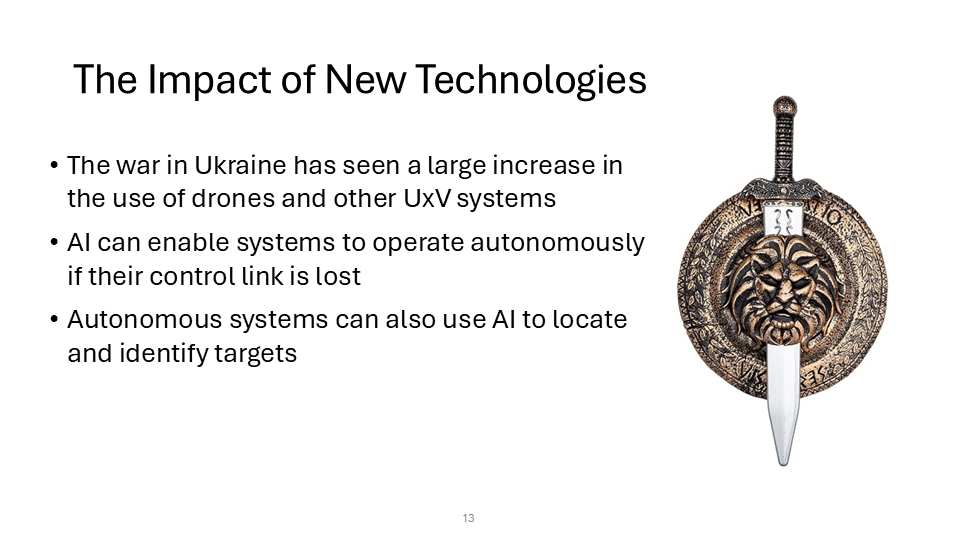
The Impact of Drones, Autonomy and New Technology
Describes the accelerated competition between offensive technology and defensive countermeasures during the war. Unmanned air, sea and ground systems—collectively UxVs—have expanded sharply, with UAVs performing offensive, defensive and intelligence, surveillance and reconnaissance roles. AI can support target identification, allow a drone to continue when its control link is lost, and in some circumstances locate targets autonomously. Inexpensive mass-produced drones have consequently changed how the conflict is fought.
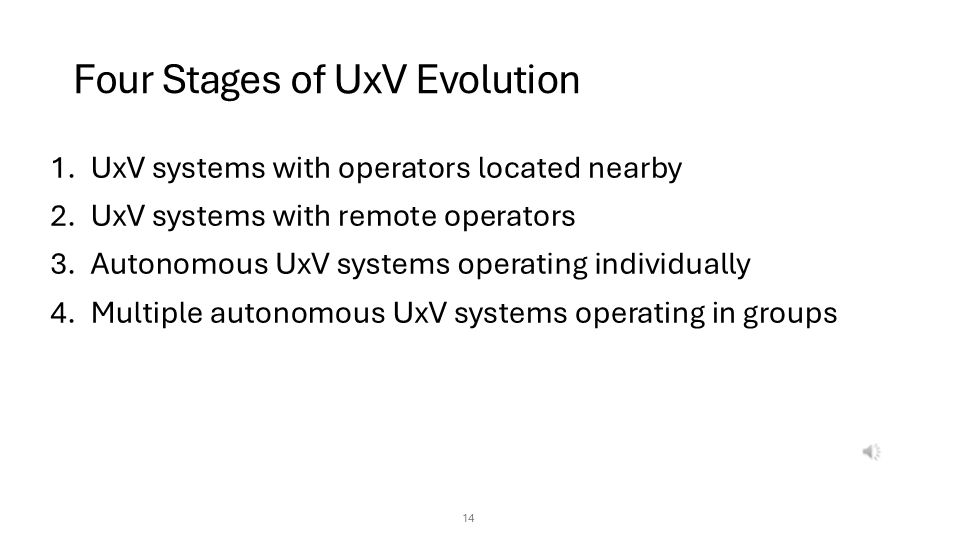
Four Stages of UxV Evolution
Proposes four stages of UxV evolution: nearby human control; remote control through extended communications; fully autonomous vehicles operating individually; and multiple autonomous vehicles collaborating as a group. AI assistance may already support navigation and targeting in the first two stages, while the third removes human intervention during the mission. The fourth stage—agents developing collective strategies—is the principal subject of the presentation.
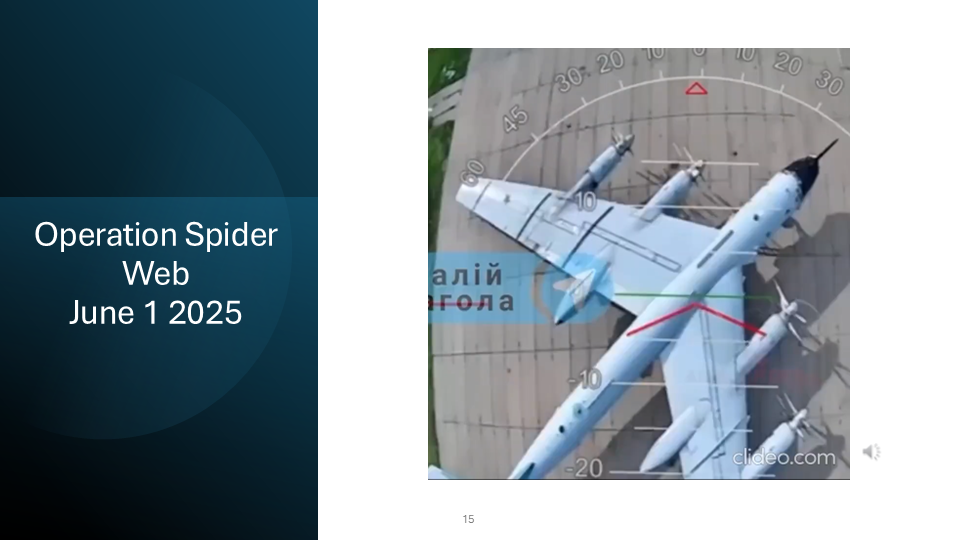
Operation Spider Web as an AI-Assisted Drone Example
Uses Ukraine’s 1 June 2025 Operation Spider Web as an example of long-range drone operations with reported AI-assisted target recognition and guidance. The presentation states that attacks on Russian airfields destroyed approximately ten aircraft and damaged more, while noting differing views about striking aircraft associated with the nuclear triad. The example is characterised as roughly stage two of UxV evolution and as a capability that collaborative swarm intelligence could move beyond.
Biological Evolution and Intelligence
Transitions from the military context to biological evolution and intelligence. This section develops the idea that evolution has produced forms of successful intelligence very different from the individual, brain-centred intelligence familiar to humans.