Artificial Swarm Intelligence for Autonomous Unmanned Systems
This presentation explains how artificial swarm intelligence could enable groups of relatively simple autonomous agents to solve complex problems collaboratively. It begins with the rapid development of unmanned systems in the war in Ukraine, then draws on biological evolution, natural swarms and emergence to show how sophisticated collective behaviour can arise from local rules without a central coordinator. A technical introduction to deep reinforcement learning covers policies, rewards, PPO and the importance of realistic training environments and carefully designed incentives. The final section presents swarm agents designed with limited sensors, small neural networks and short-range awareness, trained through modified reinforcement learning and evolutionary methods. Two- and three-dimensional simulations demonstrate grid search, obstacle traversal, continuous swarm movement, a resilient communications repeater chain, and coordinated attacks involving deconfliction, synchronisation and moving targets. The central conclusion is that appropriately trained simple agents can develop their own robust collective strategies, with natural redundancy and no single point of failure.
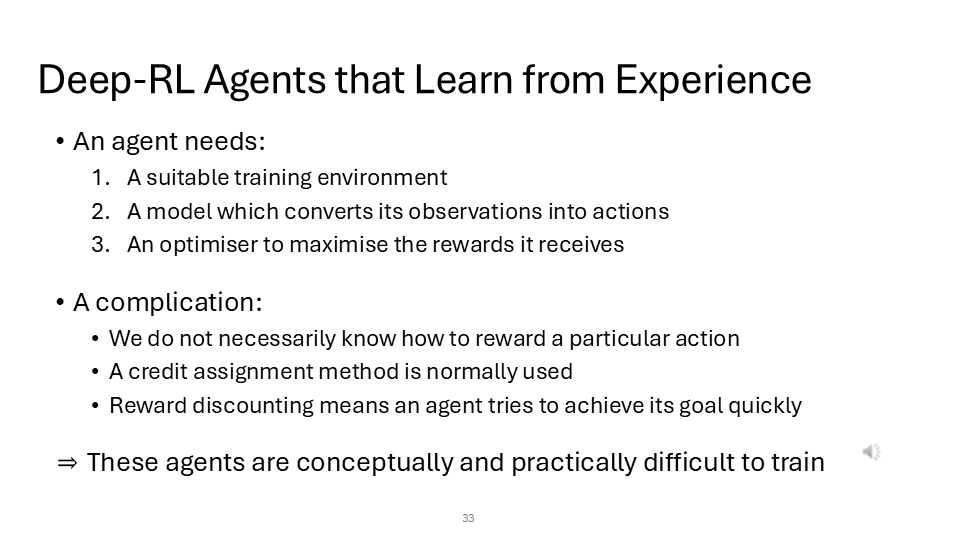
What a Deep RL Agent Needs
Lists the core requirements for a deep RL agent: a suitable environment supplying observations and rewards, a policy model converting observations into actions, and an optimiser that improves expected rewards. Credit assignment links later success to earlier actions, often using discounted future rewards. Discounting makes delayed rewards less valuable, encouraging the agent to achieve its objective sooner. These mechanisms also make practical training conceptually and computationally demanding.
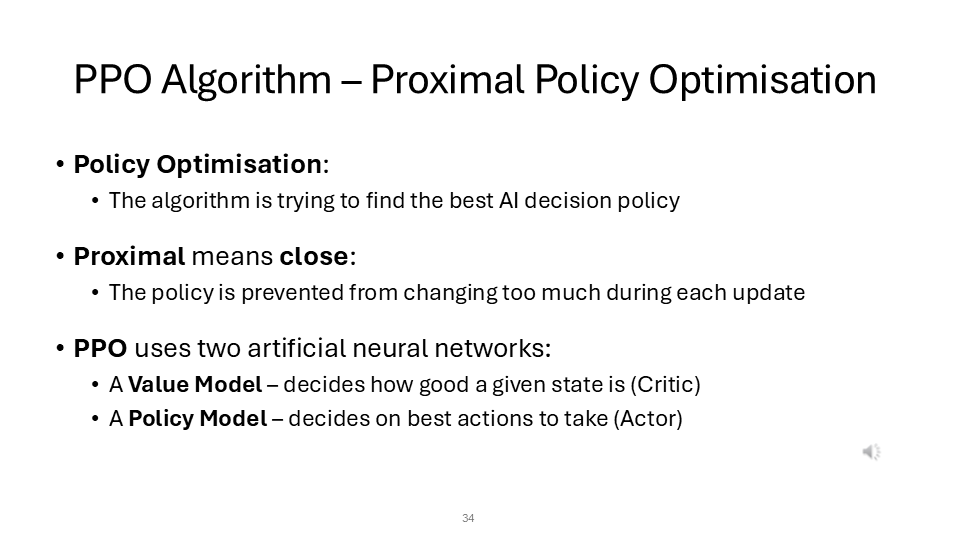
PPO: Proximal Policy Optimisation
Introduces Proximal Policy Optimisation. “Policy optimisation” means improving the decision policy, while “proximal” refers to limiting the size of each update so learning proceeds through controlled changes. PPO uses a policy network as the actor that selects actions and a value network as the critic that estimates how good a state is, making it a standard actor–critic algorithm.
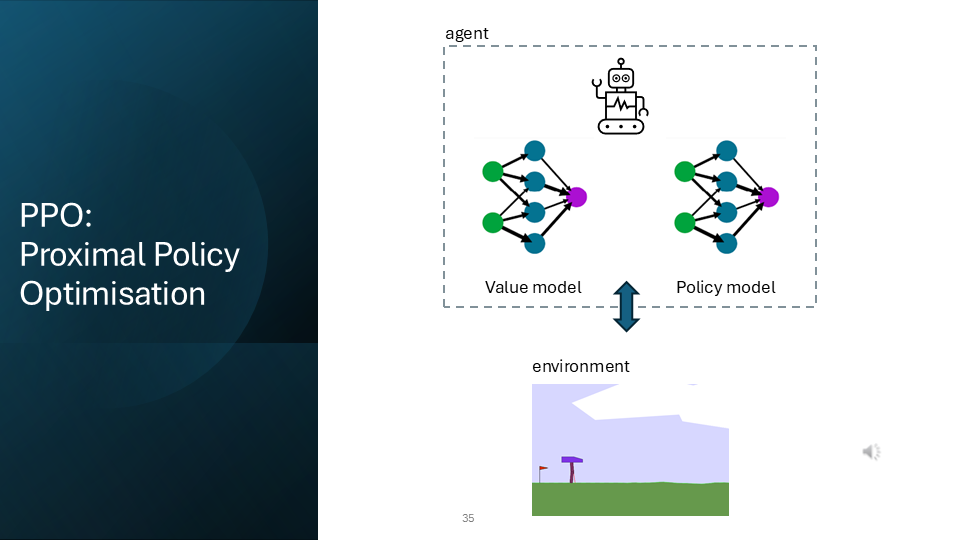
PPO Example: A Robot Learning to Walk
Shows PPO training in the Gymnasium Bipedal Walker v3 environment. The agent receives joint positions and velocities, and its policy outputs torques that control the simulated robot. Rewards and penalties reflect movement quality. The early-stage behaviour is unstable, illustrating that the policy must gradually discover coordinated control through repeated interaction rather than being explicitly programmed with a walking gait.
Lunar Lander Case Study
Introduces the lunar lander case study, a game-like Gymnasium environment used to show a deep reinforcement-learning agent progressively learning a control task.
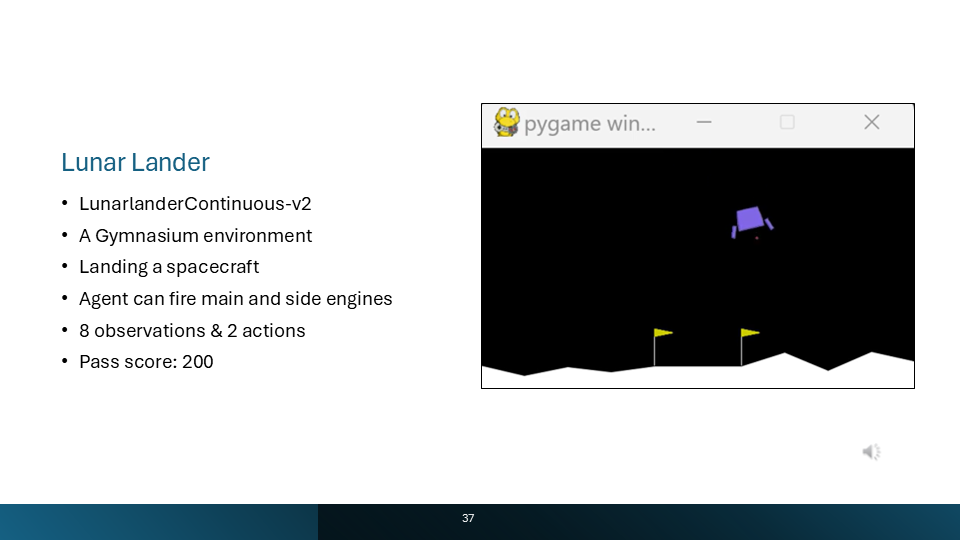
Lunar Lander Environment and Success Criteria
Defines the continuous-action LunarLanderContinuous-v2 task. The agent receives eight observations, including position, altitude and orientation, and continuously controls the main engine and lateral thrusters. It must touch down between two flags with the correct orientation and sufficiently low speed. Rewards assess the quality of its actions, and an overall score of at least 200 is required to pass.
Early Lunar Lander Attempts
Shows the agent early in training. It has begun to maintain approximately the correct orientation, but every landing still ends in failure. Across four trajectories it averages about −150 points, far below the required +200, demonstrating that partial control skills do not yet amount to a successful policy.
Passing Scores but Undesirable Landings
Shows the trained agent achieving an average score of 240, above the 200-point threshold, while exposing flaws in the original reward environment. Some landings remain inaccurate or involve undesirable manoeuvres, including touching down with engines firing and sliding toward the target. Because the environment rewards these outcomes, the agent treats them as successful. The example motivates modifying both the physical rules and reward structure rather than relying on score alone.
Improving the Lander Through Better Environment Design
Demonstrates improved behaviour after modifying the environment. Engines are cut off when a leg touches the surface, preventing powered sliding, and an instrument-landing-system-inspired descent cone rewards a controlled approach toward the landing point. Rewards are calibrated to avoid a perverse incentive to hover indefinitely inside the cone. The resulting policy descends slowly, conserves fuel and produces consistently better landings.