Artificial Swarm Intelligence for Autonomous Unmanned Systems
This presentation explains how artificial swarm intelligence could enable groups of relatively simple autonomous agents to solve complex problems collaboratively. It begins with the rapid development of unmanned systems in the war in Ukraine, then draws on biological evolution, natural swarms and emergence to show how sophisticated collective behaviour can arise from local rules without a central coordinator. A technical introduction to deep reinforcement learning covers policies, rewards, PPO and the importance of realistic training environments and carefully designed incentives. The final section presents swarm agents designed with limited sensors, small neural networks and short-range awareness, trained through modified reinforcement learning and evolutionary methods. Two- and three-dimensional simulations demonstrate grid search, obstacle traversal, continuous swarm movement, a resilient communications repeater chain, and coordinated attacks involving deconfliction, synchronisation and moving targets. The central conclusion is that appropriately trained simple agents can develop their own robust collective strategies, with natural redundancy and no single point of failure.
Lessons from the Lunar Lander
Transitions from the lunar lander demonstration to the broader practical lessons it provides about training autonomous agents.
Key Lessons for Real-World Deep RL
Concludes that real-world agents require realistic training environments because rewards are their only direct measure of success. Reward structure and shaping can strongly affect learned behaviour, while badly designed incentives can produce undesirable shortcuts despite powerful algorithms and extensive computing. The example also shows that even moderately complex reinforcement-learning tasks can demand substantial computational resources.
Part 3: Swarm AI Agents
Introduces Part 3 and the developed “swarm AI agents”: agents designed to operate collaboratively, develop collective strategies and solve problems as a group using the techniques described in the remainder of the presentation.
Creating Insect-Like AI Agents
Frames the first design question of Part 3: how to create agents that think and behave more like insects than mammals. Properly designed and trained agents are expected to collaborate naturally, retain functionality when individuals are lost, and offer useful resilience and redundancy for unmanned systems.
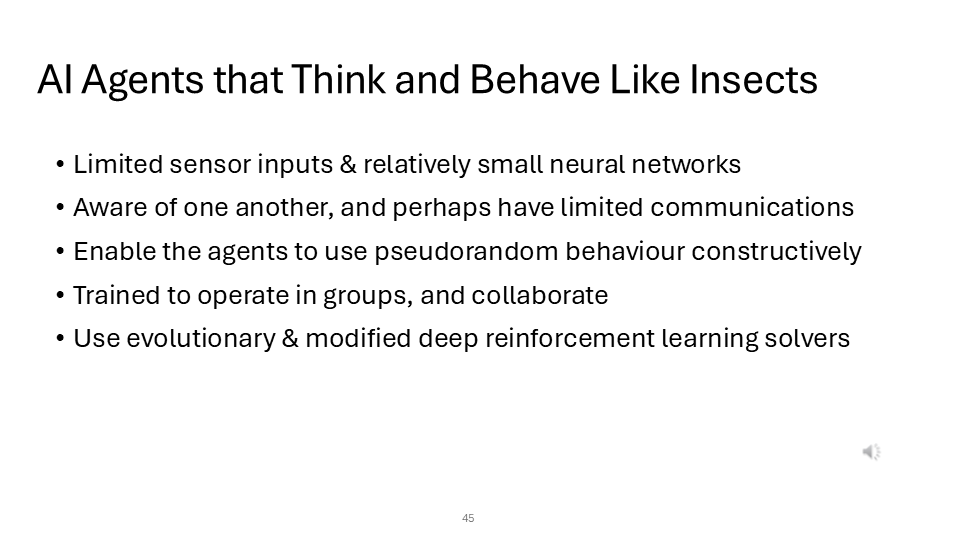
Design Principles for Insect-Like Swarm AI
Sets out the design principles for insect-like swarm agents. Each agent has limited sensors and a relatively small neural network, short-range awareness of neighbours, and sometimes restricted communications. It must also be able to use pseudorandom behaviour constructively. Deliberately constrained individual capability creates pressure to cooperate. Training combines evolutionary methods with modified deep reinforcement learning and rewards successful group operation.
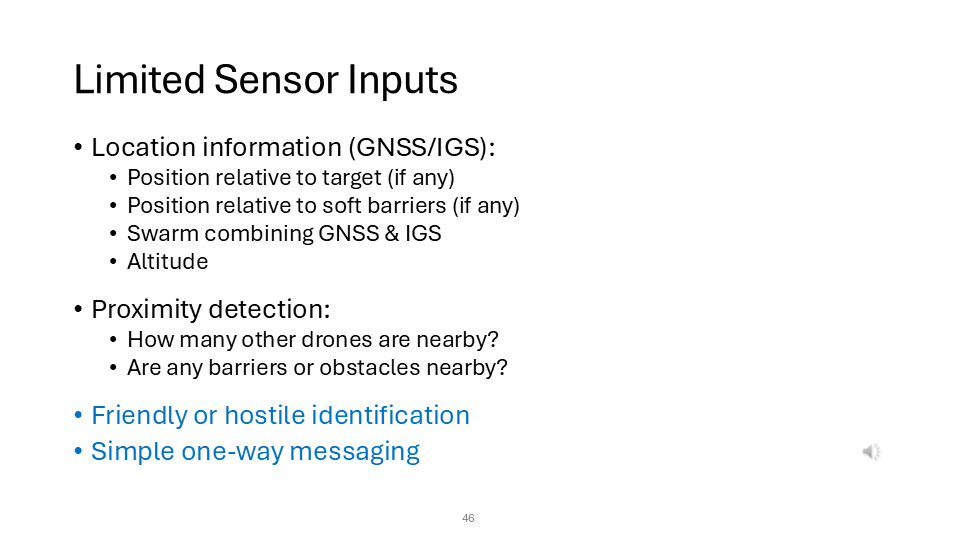
Limited Sensors and Short-Range Communications
Specifies a minimal sensor set. Agents require location information, potentially combining GNSS and inertial guidance, altitude awareness and short-range proximity detection for neighbours and obstacles. Some missions additionally need friendly-or-hostile identification and basic communications. Because electronic warfare may make long-range links unreliable, the simulations use only small, one-way asynchronous messages over short distances when inter-agent communication is included.
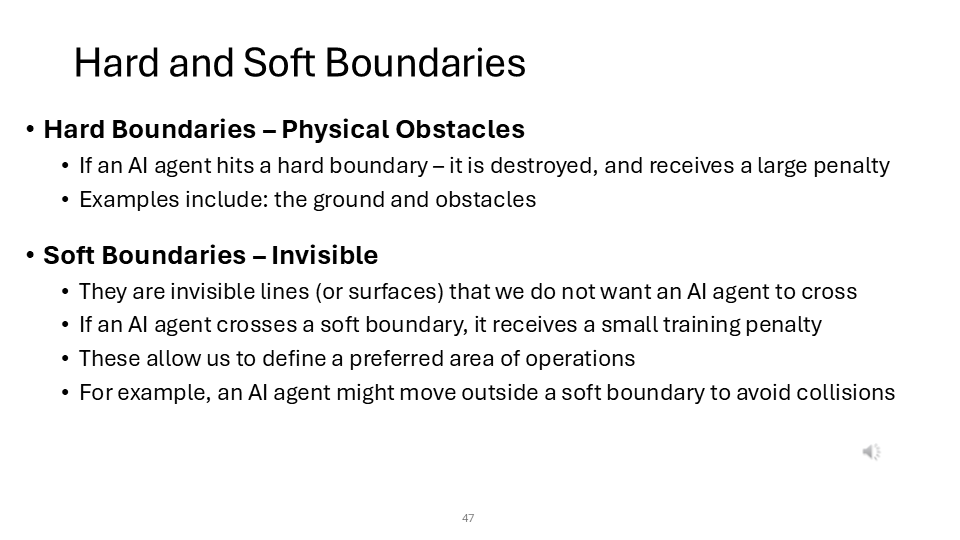
Hard and Soft Training Boundaries
Distinguishes hard and soft boundaries in training. Hard boundaries represent physical obstacles such as the ground or walls; impact destroys the agent and carries a large penalty. Soft boundaries define preferred operating regions and carry only a small penalty when crossed. This allows an agent to leave the desired area temporarily—for example, to avoid a collision—without treating the crossing as a physical crash.
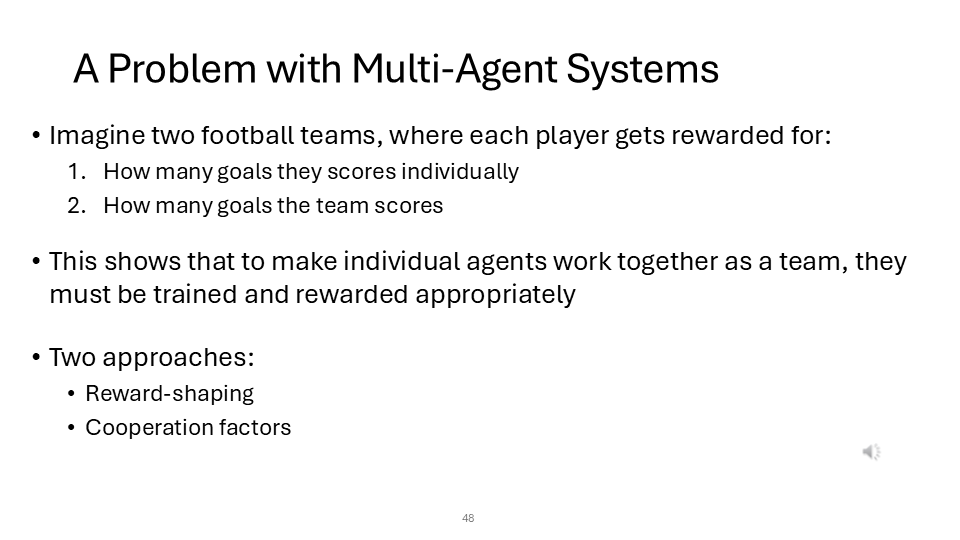
Aligning Rewards in Multi-Agent Systems
Explains the incentive problem in multi-agent learning through two football teams. Rewarding players only for personal goals discourages passing and produces interference, while rewarding the team’s total goals promotes cooperation. Swarm agents likewise need rewards that value collective performance rather than only individual success. The presented approach uses careful reward shaping and cooperation factors within the value function to encourage team behaviour.