Artificial Swarm Intelligence for Autonomous Unmanned Systems
This presentation explains how artificial swarm intelligence could enable groups of relatively simple autonomous agents to solve complex problems collaboratively. It begins with the rapid development of unmanned systems in the war in Ukraine, then draws on biological evolution, natural swarms and emergence to show how sophisticated collective behaviour can arise from local rules without a central coordinator. A technical introduction to deep reinforcement learning covers policies, rewards, PPO and the importance of realistic training environments and carefully designed incentives. The final section presents swarm agents designed with limited sensors, small neural networks and short-range awareness, trained through modified reinforcement learning and evolutionary methods. Two- and three-dimensional simulations demonstrate grid search, obstacle traversal, continuous swarm movement, a resilient communications repeater chain, and coordinated attacks involving deconfliction, synchronisation and moving targets. The central conclusion is that appropriately trained simple agents can develop their own robust collective strategies, with natural redundancy and no single point of failure.
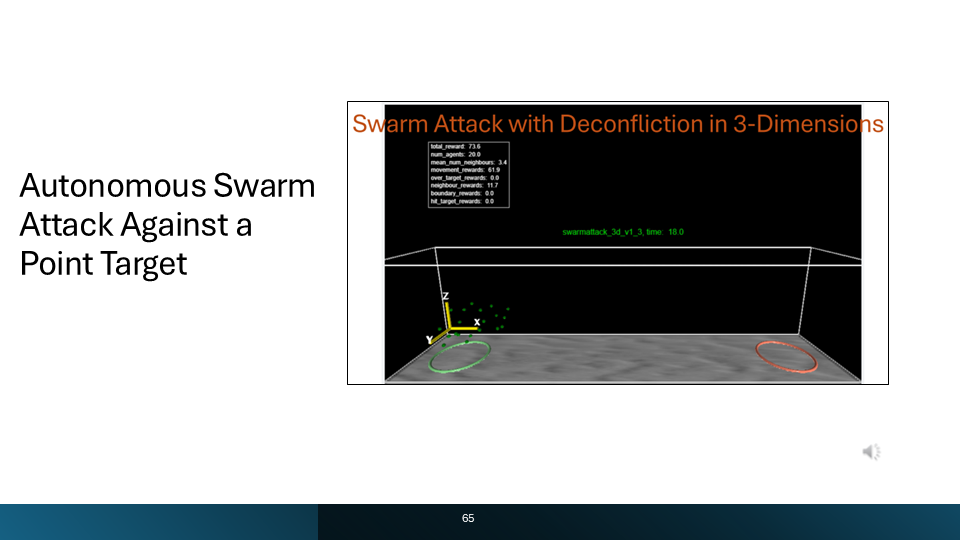
Point-Target Attack: The Deconfliction Problem
Defines the point-target task. Drones use altitude, short-range proximity sensing and relative direction to the target, but cannot communicate. Rewards encourage movement toward the target, sustained collective movement above it and detonation within effective range. Penalties discourage crashes, collisions, fratricide and soft-boundary crossings. Because simultaneous arrivals could destroy multiple attackers in the first explosion, the swarm must learn to deconflict a prolonged sequence of strikes.
Deconflicted Point-Target Attack in Action
Shows the learned solution. The swarm travels in a downward-tilted wedge, then disperses above the target. Individual drones attack sequentially while the remainder continue moving overhead, so each detonation avoids destroying other attackers. Later arrivals hold at altitude before descending. Despite small neural networks, limited sensors, no global awareness and no communication, the agents coordinate and completely destroy the target.
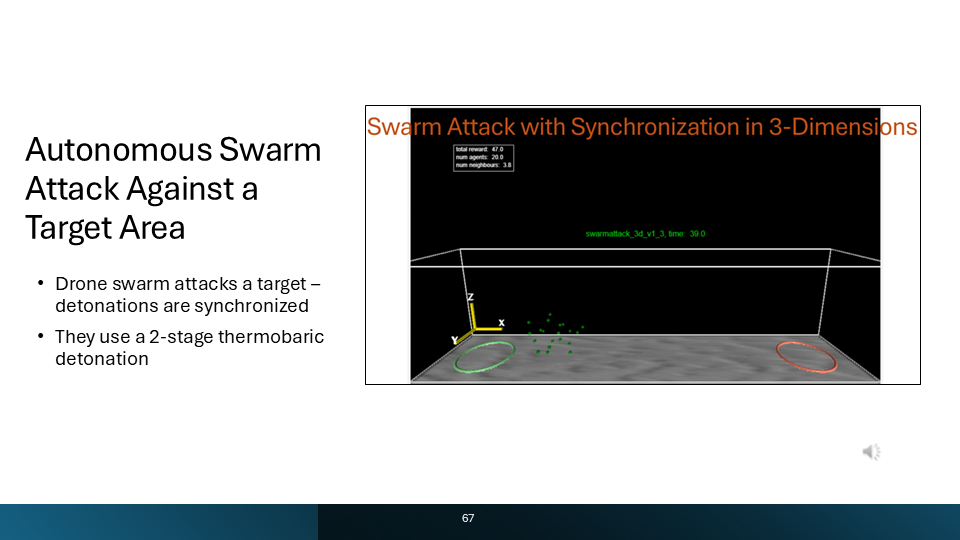
Synchronised Distributed Thermobaric Attack
Introduces a synchronised, distributed thermobaric attack against a wider target area. The agents retain limited sensing but add a short-range arming protocol. The proposed two-stage process has drones collectively disperse explosive aerosol and then ignite it after sufficient distribution, seeking an effect analogous to a large unitary thermobaric weapon. A dedicated training environment tests whether the swarm can coordinate this collective release and detonation.
Thermobaric Swarm Attack Simulation
Shows the trained swarm executing the area attack. With no enemy fire or transit hazards modelled, the drones remain in a close formation en route. Near the target they run the arming protocol and change colour, then begin releasing their aerosol payloads after a short delay. Once the cloud has dispersed sufficiently, it is ignited in a synchronised large explosion.
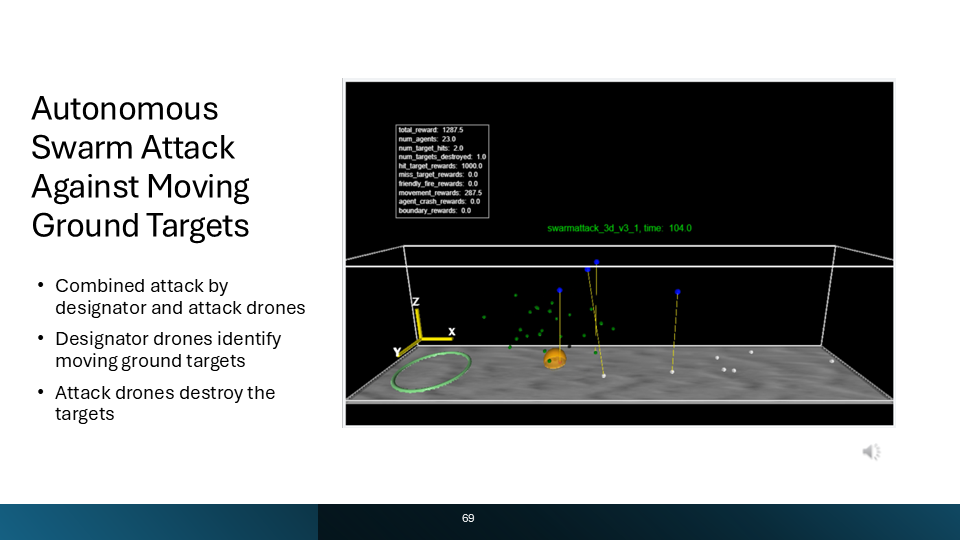
Combined Attack Against Moving Ground Targets
Defines the final scenario, which combines designator and attack drones against moving ground targets. Designators use infrared laser target designators to identify and illuminate targets; the autonomous attack drones detect illuminated objects within limited range and receive direction vectors toward them. Both drone types have restricted vision and search when no target is visible. Each ground target requires a randomly selected one to four hits, and attack drones cannot communicate with one another.
Designator and Attack Drones Working Together
Shows blue designator drones locating, tracking and illuminating moving targets, with laser paths displayed in yellow. Green attack drones engage the marked targets and deconflict their strikes. Ground targets change from white to purple when damaged and black when destroyed. As targets become scarce, both groups search the environment for survivors. The simulation ends with all ground targets destroyed.
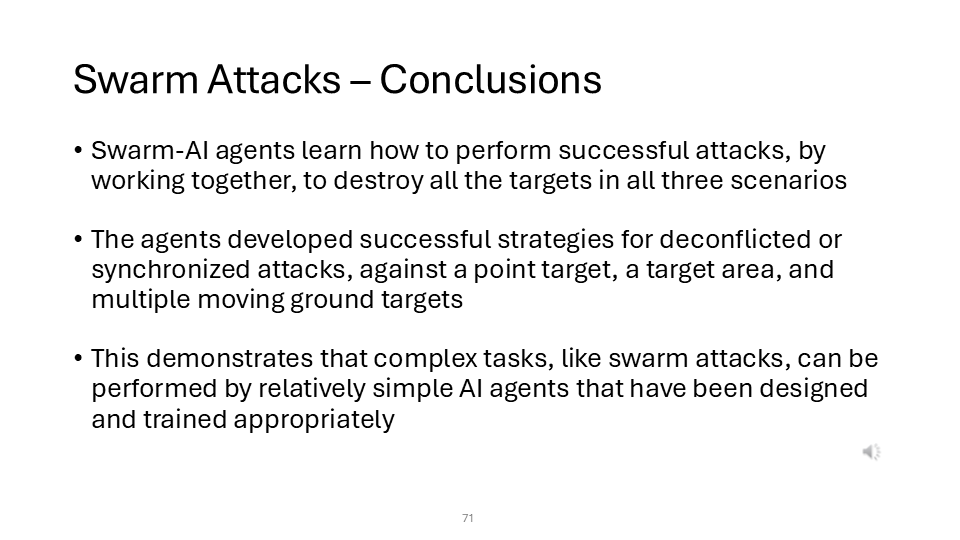
Conclusions from the Swarm Attack Simulations
Concludes that the swarm agents learned successful strategies in all three attack scenarios. Their behaviour included sequential deconfliction, synchronised area effects and cooperation between designator and attack roles against moving targets. All simulated targets were destroyed. The results support the presentation’s central claim that appropriately designed and trained agents with limited individual capabilities can collectively perform complex coordinated tasks.
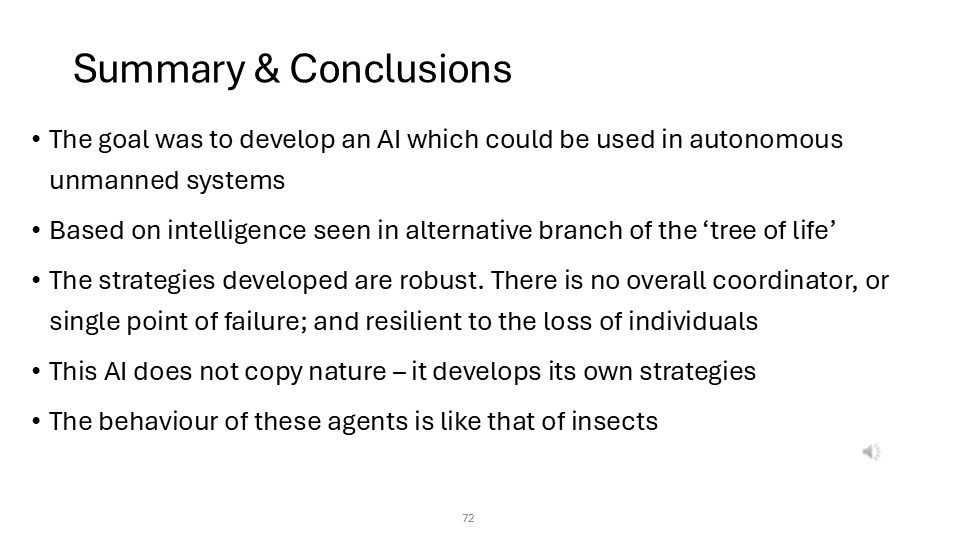
Summary and Conclusions
Summarises the project’s aim of developing AI for autonomous unmanned systems in Ukraine. The approach draws inspiration from insect-like collective intelligence and possible emergence, enabling simple agents to cooperate on complex tasks. Learned strategies are decentralised, resilient to individual losses and free from a single coordinating point of failure. The agents do not merely reproduce natural swarming; they develop tactics for their assigned goals, although their resulting behaviour often resembles insects by design.