Artificial Swarm Intelligence for Autonomous Unmanned Systems
This presentation explains how artificial swarm intelligence could enable groups of relatively simple autonomous agents to solve complex problems collaboratively. It begins with the rapid development of unmanned systems in the war in Ukraine, then draws on biological evolution, natural swarms and emergence to show how sophisticated collective behaviour can arise from local rules without a central coordinator. A technical introduction to deep reinforcement learning covers policies, rewards, PPO and the importance of realistic training environments and carefully designed incentives. The final section presents swarm agents designed with limited sensors, small neural networks and short-range awareness, trained through modified reinforcement learning and evolutionary methods. Two- and three-dimensional simulations demonstrate grid search, obstacle traversal, continuous swarm movement, a resilient communications repeater chain, and coordinated attacks involving deconfliction, synchronisation and moving targets. The central conclusion is that appropriately trained simple agents can develop their own robust collective strategies, with natural redundancy and no single point of failure.
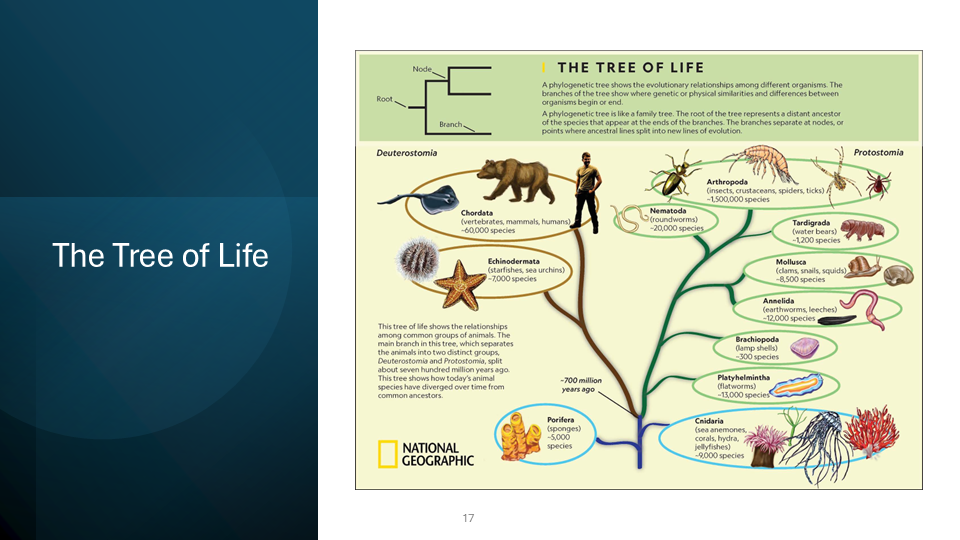
The Tree of Life and Collective Intelligence
Contrasts the vertebrate branch of animal evolution, which includes humans, with the arthropod branch, which includes insects and spiders. Insects are presented as exceptionally successful by abundance and biomass. Ant colonies show how small creatures with tiny individual brains can coordinate through mechanisms such as pheromone trails and collectively perform complex tasks. Their success motivates swarm intelligence as an alternative model to reliance on large, individually capable organisms.
Swarm Intelligence and Emergence
Introduces the final background topic by linking swarm intelligence to emergence. The section will explain how complex collective properties can arise from interactions among simple components and why this connection is useful for understanding autonomous multi-agent systems.
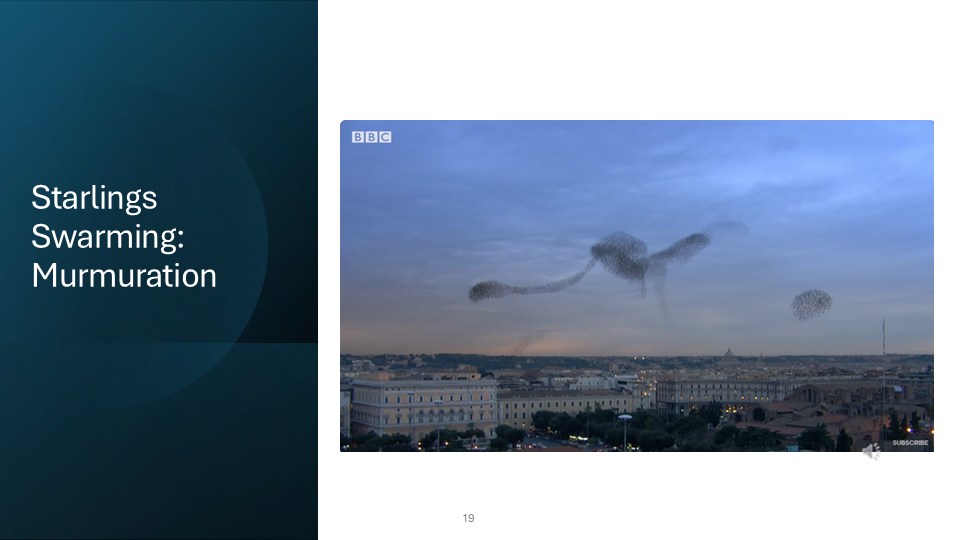
Starling Murmurations from Three Simple Rules
Uses starling murmurations to demonstrate emergent collective behaviour without a central coordinator or prescribed flight paths. A convincing model can arise from three local rules: separation to avoid crowding, cohesion toward neighbours’ centre of mass, and alignment with neighbours’ velocities. The complex moving patterns emerge from each bird following simple rules independently. This principle—simple local behaviour generating sophisticated group behaviour—becomes a recurring foundation for the swarm AI design.
Simulating Swarm Behaviour Without AI
Presents a two-dimensional mathematical simulation implementing separation, cohesion and alignment, plus a rule keeping agents inside a square. Complex patterns arise naturally, and changing the relative strength of the rules produces many behaviours. The key lesson is that basic swarming itself does not necessarily require AI; ordinary mathematics can generate it. AI becomes relevant when agents must learn strategies for broader operational goals and changing challenges.
Should Drones Copy Natural Swarms?
Asks whether drones should imitate natural swarming rather than whether they technically can. Dense swarming may be suitable when the task resembles predator avoidance or overwhelming defences, but in other settings it can create a concentrated, target-rich formation. The recommended approach is to train autonomous systems to solve the actual operational problem, allowing the resulting formation—clustered or dispersed—to follow from the objective and environment.
Emergence: Complex Behaviour from Simple Rules
Defines emergence as large-scale properties or behaviours that arise from interactions among components but are not obvious from the components individually. It contrasts this with a purely reductionist view and notes that complex systems can be chaotic, self-organising or spontaneously structured. Emergence is presented as real but counter-intuitive, with even space and time mentioned as speculative examples of potentially emergent phenomena in theoretical physics.
Brian’s Brain: A Cellular Automaton Example
Illustrates emergence with Brian’s Brain, a cellular automaton devised by Brian Silverman in 1984 and related to Conway’s Game of Life. Each cell occupies one of three states and updates solely from neighbouring cells, yet the grid develops intricate, dynamic large-scale patterns. The example shows that simple local mathematical rules can produce behaviour that is difficult to predict or understand, preparing the link to decentralised UxV coordination.
Why Emergence Matters for UxV Systems
Applies emergence to unmanned warfare. Sophisticated group behaviour need not require either a central coordinator or complicated software in every vehicle; relatively simple local controllers could collectively generate complex outcomes. Such decentralisation removes an obvious single point of failure and creates natural redundancy, making the group resilient when individual drones or robots are lost.