Artificial Swarm Intelligence for Autonomous Unmanned Systems
This presentation explains how artificial swarm intelligence could enable groups of relatively simple autonomous agents to solve complex problems collaboratively. It begins with the rapid development of unmanned systems in the war in Ukraine, then draws on biological evolution, natural swarms and emergence to show how sophisticated collective behaviour can arise from local rules without a central coordinator. A technical introduction to deep reinforcement learning covers policies, rewards, PPO and the importance of realistic training environments and carefully designed incentives. The final section presents swarm agents designed with limited sensors, small neural networks and short-range awareness, trained through modified reinforcement learning and evolutionary methods. Two- and three-dimensional simulations demonstrate grid search, obstacle traversal, continuous swarm movement, a resilient communications repeater chain, and coordinated attacks involving deconfliction, synchronisation and moving targets. The central conclusion is that appropriately trained simple agents can develop their own robust collective strategies, with natural redundancy and no single point of failure.
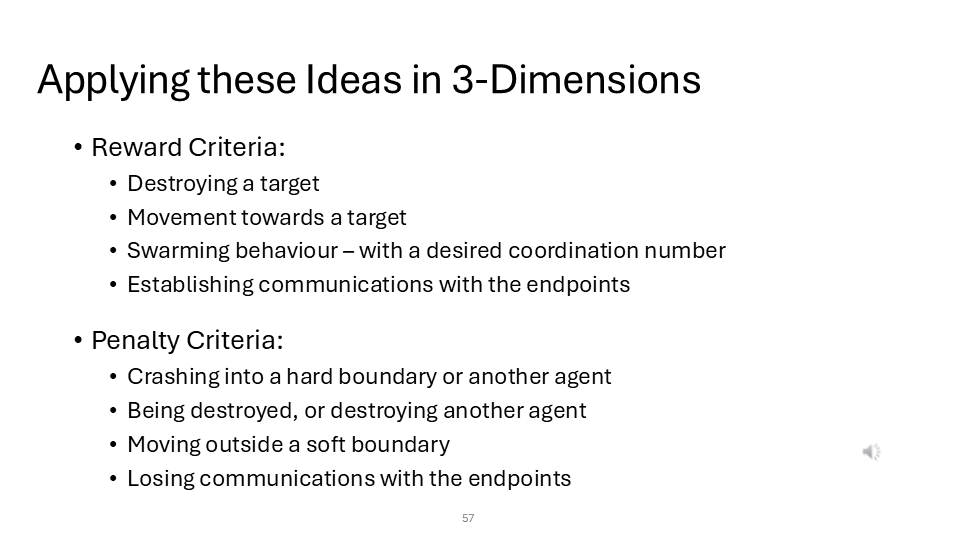
Rewards and Penalties in 3D Environments
Summarises the reward design for three-dimensional tasks. Attack agents receive major rewards for destroying targets and smaller rewards for movement toward targets or maintaining desired swarm density. Penalties cover crashes, collisions, losses to enemy fire, friendly destruction and soft-boundary violations. In the repeater-chain task, agents are additionally rewarded for connecting and maintaining communications between endpoints and penalised when those links fail.
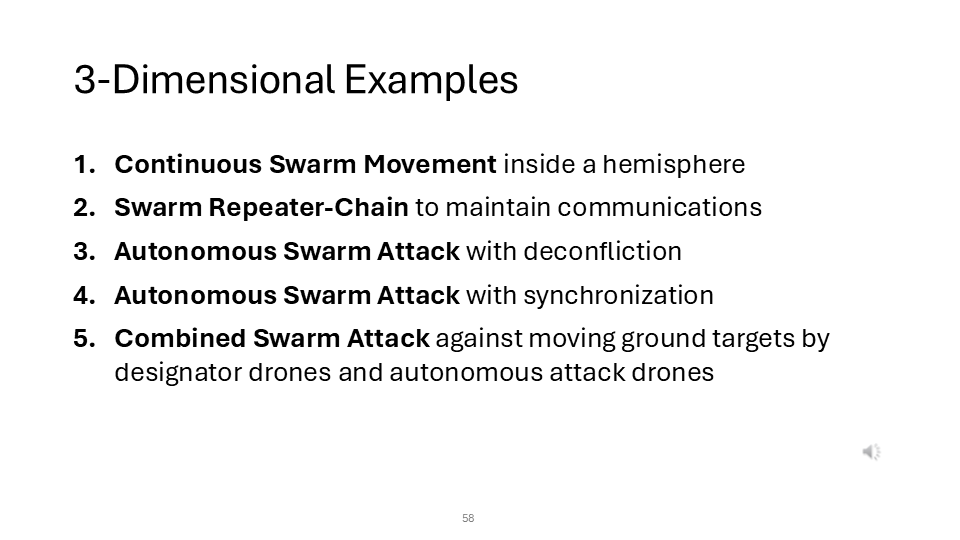
Five Three-Dimensional Examples
Lists five three-dimensional examples: continuous movement within a hemisphere; a dynamic communications repeater chain; a prolonged deconflicted attack on a point target; a synchronised distributed thermobaric attack on a wider area; and a combined operation in which designator drones and autonomous attack drones engage moving ground targets.
Continuous Swarm Movement in a Hemisphere
Shows a swarm taking off and maintaining continuous movement within a hemispherical volume. The ground is a hard boundary and the hemisphere a soft one. Short-range proximity sensors allow agents to detect imminent collisions only when close; they then separate, often moving toward but rarely through the hemisphere’s boundary. Rewards for continued movement and penalties for collisions or crashes produce stable collective operation within the required space.
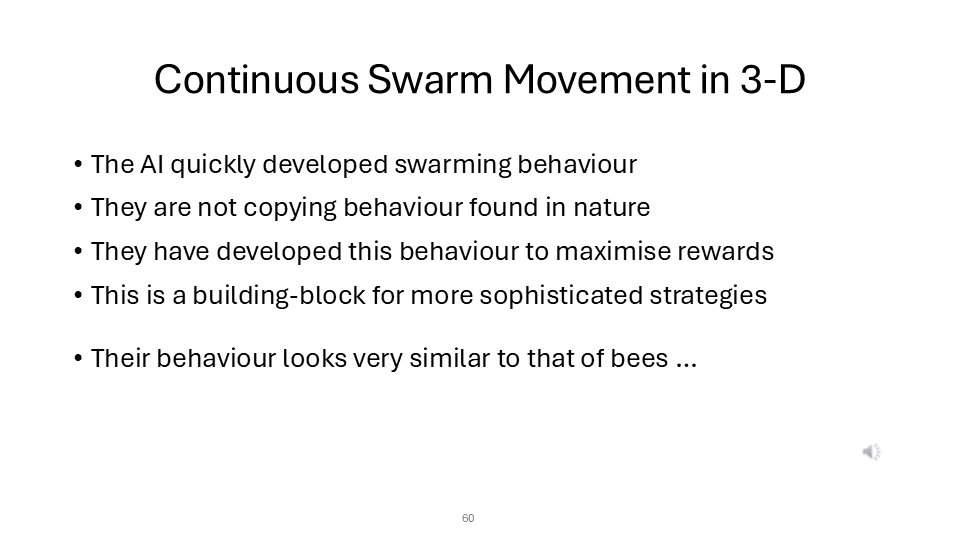
Why Bee-Like Movement Emerged
Interprets the hemisphere result. The agents rapidly developed bee-like swarming behaviour, but this was not programmed as an imitation of nature. It arose because that behaviour maximised rewards for continuous movement within the required volume while avoiding collisions and the ground. The learned capability can serve as a building block within more sophisticated collective strategies.
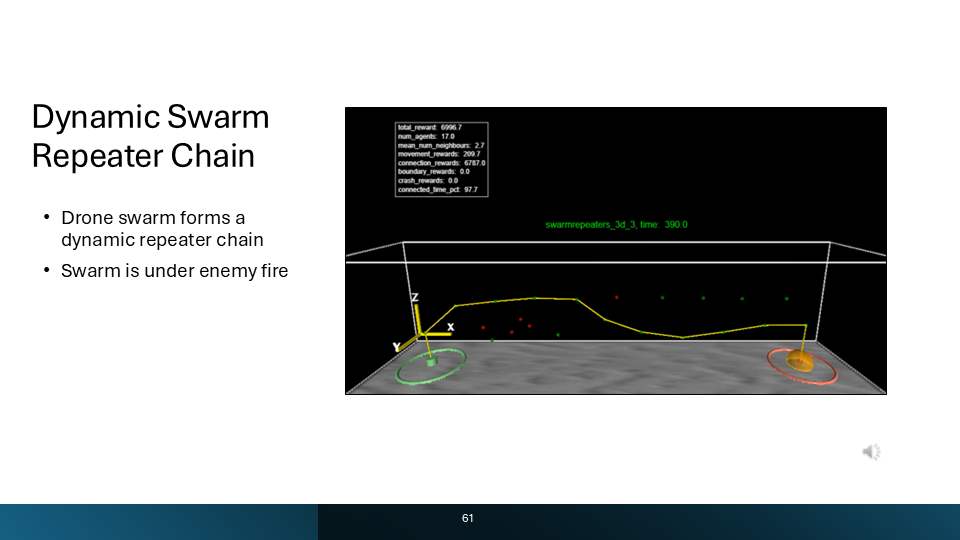
Dynamic Swarm Communications Repeater Chain
Defines a dynamic repeater-chain task. Green autonomous drones act as short-range mobile relays between a ground pilot and a moving attack or ISR drone. Each agent knows only nearby conditions and, when connected, the direction toward one or both endpoints. The swarm must continually rearrange itself as the remote vehicle moves, while effective enemy fire removes relay drones. The objective is to preserve a long-distance communications path despite limited information and losses.
A Self-Healing Repeater Chain Under Fire
Shows the repeater chain operating, with the shortest viable path displayed between the moving drone and ground pilot. Although many relay drones are destroyed, survivors reconfigure themselves and communication suffers only brief interruptions. The learned chain is self-healing and includes redundancy, allowing the attack drone to remain connected and destroy its target despite substantial degradation.
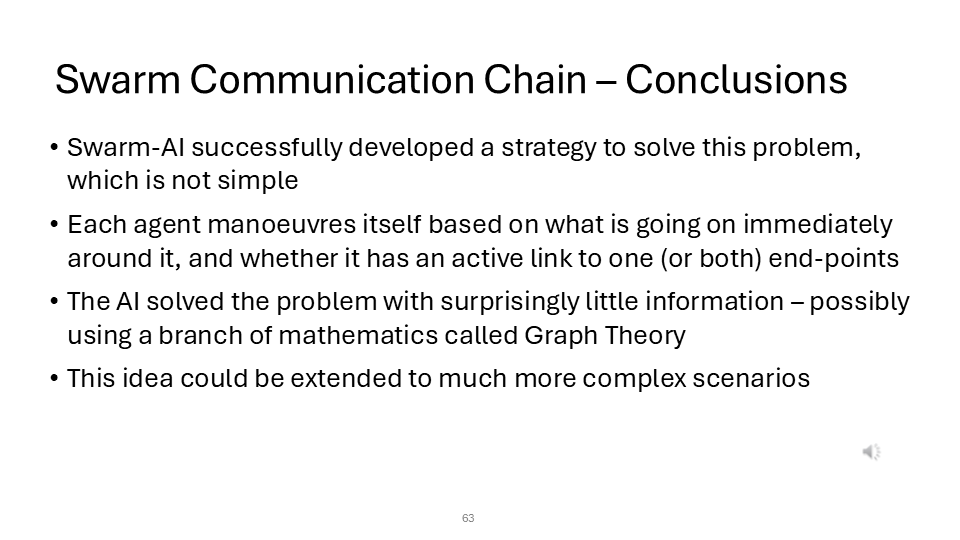
Extending the Swarm Communications Mesh
Concludes that simple agents can solve the non-trivial repeater-chain problem using local information and endpoint connectivity, possibly in a way describable through graph theory. The concept could extend to a distributed battlefield mesh linking multiple attack drones, ISR assets and operators. Combining radio-frequency and optical links with robust protocols is proposed as a way to increase resistance to electronic warfare.
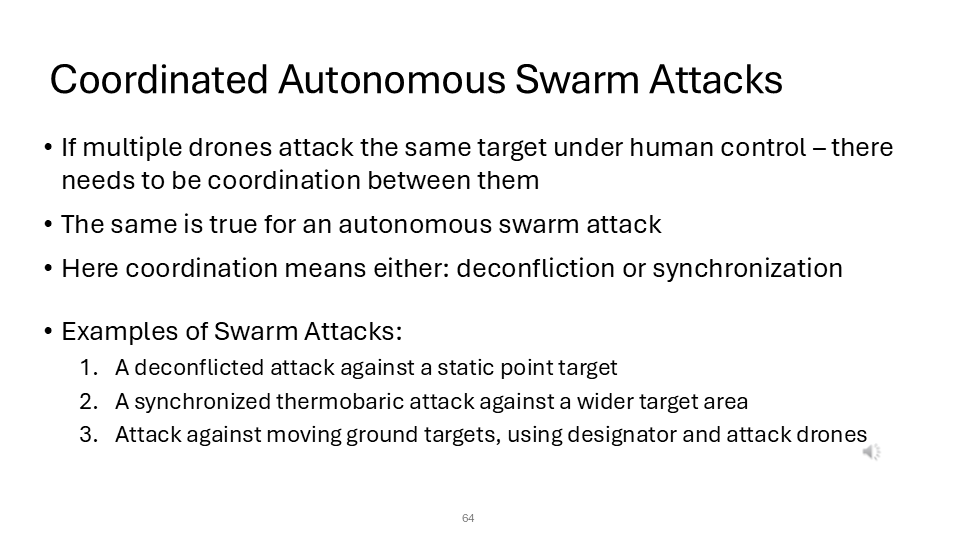
Deconfliction and Synchronisation in Swarm Attacks
Introduces three coordinated attack cases and distinguishes two forms of coordination. Deconfliction prevents attackers from interfering with or destroying one another, while synchronisation combines their effects at the required time. The examples are a prolonged deconflicted attack on a static point target, a synchronised thermobaric attack across a larger area, and a combined designator-and-attack-drone operation against moving ground targets.