Artificial Swarm Intelligence for Autonomous Unmanned Systems
This presentation explains how artificial swarm intelligence could enable groups of relatively simple autonomous agents to solve complex problems collaboratively. It begins with the rapid development of unmanned systems in the war in Ukraine, then draws on biological evolution, natural swarms and emergence to show how sophisticated collective behaviour can arise from local rules without a central coordinator. A technical introduction to deep reinforcement learning covers policies, rewards, PPO and the importance of realistic training environments and carefully designed incentives. The final section presents swarm agents designed with limited sensors, small neural networks and short-range awareness, trained through modified reinforcement learning and evolutionary methods. Two- and three-dimensional simulations demonstrate grid search, obstacle traversal, continuous swarm movement, a resilient communications repeater chain, and coordinated attacks involving deconfliction, synchronisation and moving targets. The central conclusion is that appropriately trained simple agents can develop their own robust collective strategies, with natural redundancy and no single point of failure.
Two-Dimensional Swarm Simulations
Introduces two simple two-dimensional swarm environments. Grid Searcher examines how highly constrained ant-like agents cover an area, while traversal examples show collective movement, obstacle navigation, sustained activity over a target and a coordinated attack. These simulations establish key principles before the more complex three-dimensional cases.
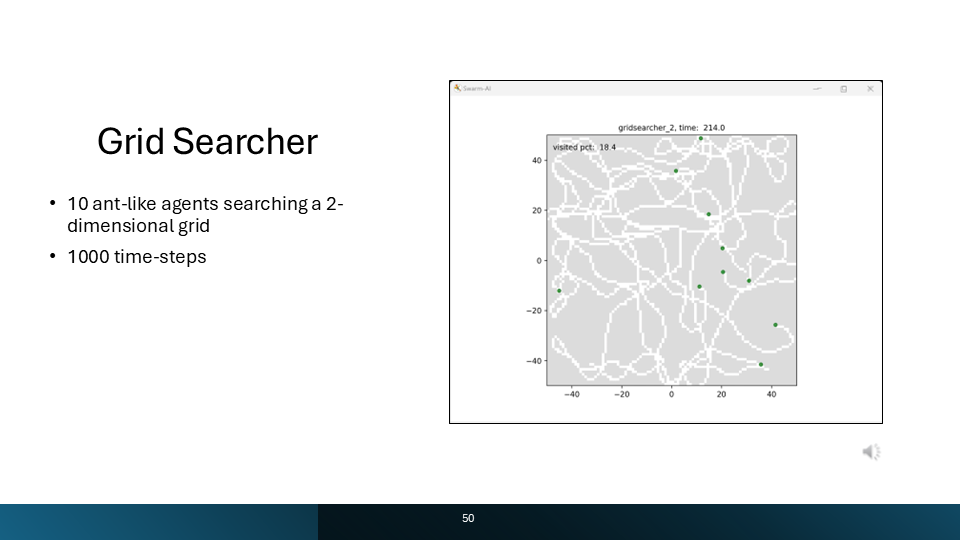
Grid Searcher Environment
Defines Grid Searcher: ten ant-like agents explore a 100×100-cell grid for 1,000 time steps, earning one point for each newly visited cell. They know only their speed and whether another agent or boundary is within a short proximity range. They have no position information, map, memory or communication, and their neural networks control only thrust vectors. These severe constraints make systematic coverage appear difficult.
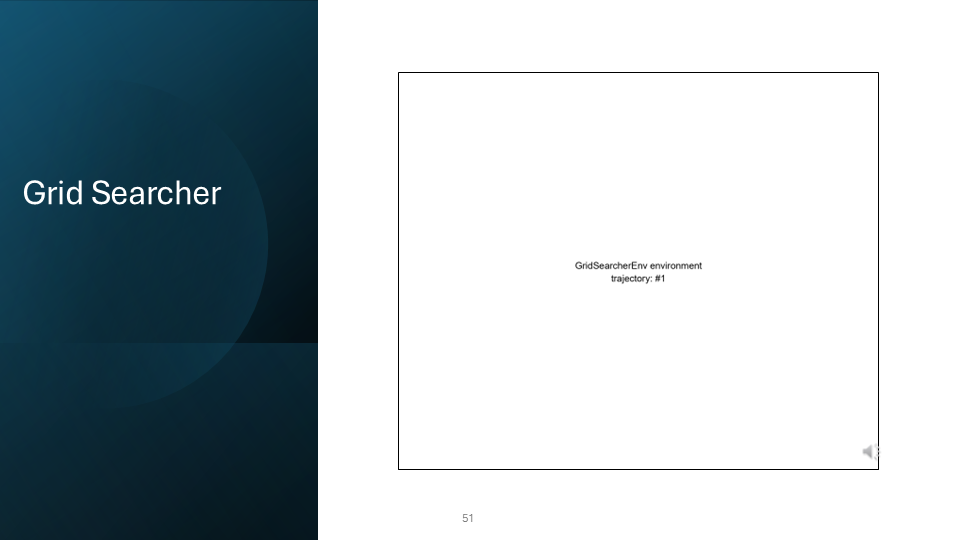
Grid Searcher Results: Constructive Pseudorandomness
Shows that the constrained Grid Searcher colony typically visits 60–70% of the cells that a perfect strategy could cover. The agents avoid most collisions and generally remain within the boundary, yet their paths appear random and disorganised. Their performance is attributed to constructive pseudorandom behaviour rather than an intuitively recognisable search pattern. The result also warns that effective machine-developed strategies may not always be easy for humans to understand.
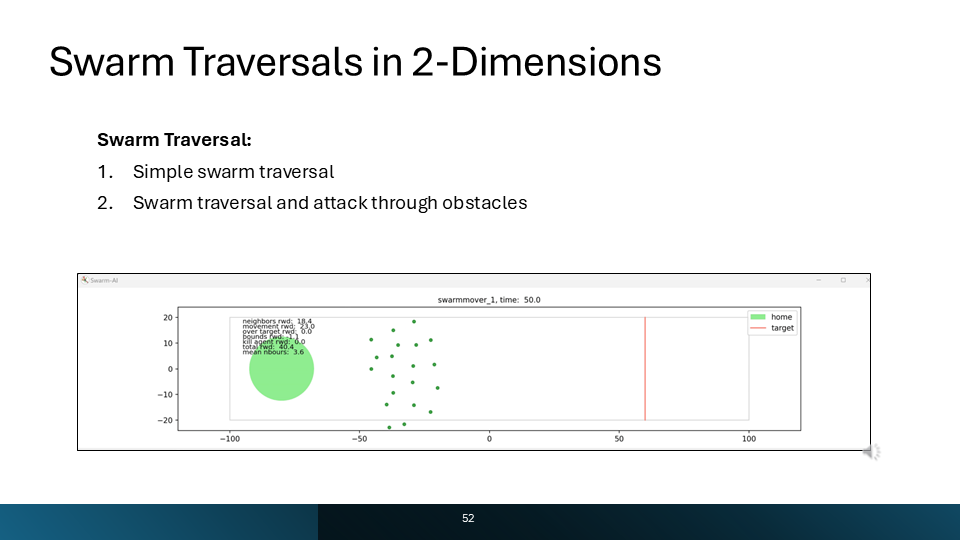
Two-Dimensional Swarm Traversal Tasks
Defines two traversal tasks in which agents leave a circular launch zone, cross an elongated region and enter a target area. Rewards encourage movement toward the target and a desired neighbour density, while penalties discourage boundary violations, collisions and obstacle impacts. One case requires only sustained swarm movement; the other includes obstacles and a large reward for synchronised detonation. The tasks show how agents may accept small immediate penalties to obtain larger later rewards.
Emergent Formation During Swarm Traversal
Shows agents leaving a dense launch area and spontaneously reorganising into a regular moving formation with the desired number of nearby neighbours. Each agent senses only close neighbours, yet the collective structure emerges without global awareness. Near the target, the swarm becomes denser and maintains continuous movement over the area. The result demonstrates how learned local rules can generate the intended group-level behaviour.
Obstacle Traversal and Synchronised Attack
Adds obstacles and a synchronised attack to the traversal. With only short-range sensing, agents break formation, sometimes cross the soft boundary and disperse to navigate around obstacles. Near the target they use short-range one-way messages in an arming protocol before detonating. The behaviour reinforces that agents should learn tactics appropriate to goals and hazards rather than being trained merely to preserve a natural-looking swarm formation.
Three-Dimensional Swarm Simulations
Introduces the three-dimensional simulation section. It will explain changes from two-dimensional training, identify the relevant reward and penalty structures, and then demonstrate continuous movement, a dynamic communications repeater chain under effective enemy fire, and three coordinated autonomous attack scenarios.
Extending Swarm Training from 2D to 3D
Explains that the three-dimensional workflow closely follows the two-dimensional one: relative-position and velocity calculations use the same form, with one extra vector component. Additional considerations include gravity, altitude and the ground as a hard boundary. Three-dimensional learning generally requires more computation because the environment and action space are more complex.